Tuesday, December 1, 2015
Aloha e Friends,
Merry Christmas and Happy Holidays! The 15th Annual Kapolei City Lights will take place on Saturday, December 12th from 3pm to 9pm at Kapolei Hale. The Marketplace, including a craft fair, farmers market, public services booth, entertainment, and Keiki Village, will kick-off at 3pm. The parade will begin at 6pm, going from Kapolei Parkway at Kapolei Middle School and ending before the right turn at Kama‘aha Avenue. The tree lighting ceremony will be at 7:15pm.
As always, feel free to contact me at 586-6830 or email sengabbard@capitol.hawaii.gov if I can help you or your family in any way. You can also follow me on Twitter @senmikegabbard, Instagram @sengabbard, or Facebook at https://www.facebook.com/senmikegabbard.

Tuesday, December 1, 2015
Aloha+ Challenge Legislative and Policy Retreat
 I co-sponsored the Aloha+ Challenge Legislative and Policy Retreat at the State Capitol with Rep. Ryan Yamane and Rep. Chris Lee on November 17th. This retreat brought together close to 100 elected officials, government employees, and non-profit experts to move ahead on our state sustainability goals. Hawai‘i Green Growth (HGG) was a big partner in making this happen. HGG is a public-private partnership of more than 60 Hawai‘i sustainability leaders from government, non-governmental and cultural organizations, business and academia.
It was just a year ago that former Governor Neil Abercrombie, our 4 mayors, and the Office of Hawaiian Affairs launched the Aloha+ Challenge, a shared statewide commitment to six interconnected sustainability targets to be achieved by 2030. The Aloha+ Challenge outlines ambitious, yet achievable targets in the areas of clean energy, local food production, natural resource management, solid waste reduction, smart sustainable communities (including climate resilience), and green jobs and education. These targets provide a framework to set priorities, catalyze action and track progress on shared goals.
Since last year, the state, counties and OHA have worked with statewide partners from HGG to identify shared priorities for action and created the online Aloha+ Challenge Dashboard, which enables us to track progress on these targets. At the launch for the Aloha+ Challenge Dashboard earlier this year, I announced that I would work with HGG to convene the first Aloha+ Challenge Legislative Retreat with leaders from the Legislature and key partners and experts from government, non-profits, business, education and philanthropy to identify strategic priorities and develop a joint action agenda.
The purpose of this retreat was to develop high-impact Aloha+ Challenge joint priorities and leadership commitments that we can highlight at the upcoming World Conservation Congress in September 2016. As host of the 2016 World Conservation Congress, Hawai‘i will be on the world stage to highlight our achievements and commitments in conservation, innovation, resilience, and sustainability. I'm particularly excited about the ways we leverage the international spotlight to accelerate progress and demonstrate our commitment to action. This next legislative session presents an important opportunity to focus on high-impact priorities for policy, funding and implementation that will advance the Aloha+ Challenge sustainability targets in 2016 and create a means for implementation by 2030. What I love about Aloha+ Challenge is everyone has a seat at the table - county, state, federals, non-profits, and the private sector - truly a kakou thing - all of us, getting out of our silos, sharing ideas and working toward our sustainability goals together.
Read More
Tuesday, December 1, 2015
TOTUS Awards Highlight Tea Production in Hawai‘i
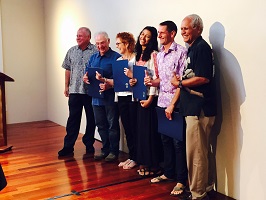 I participated in the Tea of the United States (TOTUS) Awards in Volcano on Hawai‘i Island on November 7th. Senator Russell Ruderman and I presented Honorary Certificates from the State Senate to the organizers of TOTUS and the following judges who are all tea experts from around the country: Jane Pettigrew, Bruce Richardson, David De Candia, Selena Ahmed, Kevin Gascoyne, and Stephen Rouelle. The TOTUS Awards is the first national tea competition specifically for U.S. grown tea. Tea is a significant niche crop that has a lot of future potential in the islands. As background, tea originated in southwest China and the top producing countries of tea are China, India, Kenya, Sri Lanka, and Turkey. The U.S. Tea Industry is an $11 billion business, but much of that economic impact stems from imported tea leaves. Tea was introduced to Hawai‘i in the late 1800s, but wasn't as profitable as pineapple and sugarcane. In the 1980s, the U.S. Department of Agriculture, along with UH's College of Tropical Agriculture and Human Resources, aided in research to establish tea cultivars. Most tea in Hawai‘i is grown on the Hilo side of Hawai‘i Island. I'm hopeful tea has a bright outlook in our islands!
Read More
Tuesday, December 1, 2015
Hawai‘i Farmers Union United Convention
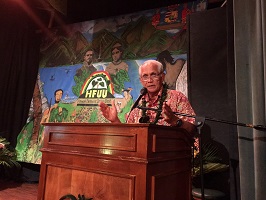
My daughter, Congresswoman Tulsi Gabbard and I were keynote speakers at the Hawai‘i Farmers Union United (HFUU) Annual Convention on November 13th on Maui. The theme of the convention was the "International Year of Soils." HFUU is a member of the National Farmers Union, which was established in 1902, and they have nine chapters statewide. They are dedicated to supporting local community agriculture and food production. In 2010, I had the privilege of recognizing HFUU with a floor presentation in the State Senate Chambers for their outstanding work. My keynote speech focused on how sustainable community food systems, such as organic and natural farming, can be just as productive as the industrial model of farming, characterized by large-scale mono-crops with heavy use of pesticides and petroleum-based fertilizers. Leading up to the 2016 session, as Chair of the Water, Land, and Agriculture Committee, I'm already working with HFUU on farm mentoring and nutrient cycling program legislation and plan to work with all our farmers to find solutions to high electricity costs; access to secure affordable land; housing costs; labor costs, access to markets; need for scaled production and consistency of supply; access to finance capital; and education and training needs.
Read More
Tuesday, December 1, 2015
It's Time To Fix The Hawaii State Capitol Reflecting Pools
The following article I wrote was posted by Honolulu Civil Beat on November 30, 2015.
Have you ever visited our State Capitol and noticed a funky, bad smell coming from the murky, algae-filled unsightly water in the Reflecting Pools surrounding the building? Well, that's just part of the problem. Over the years the pool has leaked many times, causing damage to the electrical system and air conditioning in the building. Furthermore, it costs $100,000 annually for state workers to continually clean the pool waters, which are fed by brackish water from wells. The latest estimate is that it would take approximately $15.2 million to fix the Reflecting Pools. Unfortunately, even if we spent that much money, we'd still have to come back in several years and do it all over again, because there will always be leaks. So what's the solution?
The backstory is that the State Capitol was built in 1969 and is on both the National Register of Historic Places and the State Register of Historic Places. The Reflecting Pools are a combined 77,000 square feet in size and the waterproofing membrane below the Pools hasn't been replaced in all those years. A major problem is that there's inadequate water circulation which causes the water to stagnate and there's also no filtration system. People have repeatedly thrown fish into the Pools, which worsens the situation. There have actually been sightings of a barracuda!
In 2004, the state Department of Accounting and General Services (DAGS), the entity responsible for the Capitol grounds, released a study estimating it would cost about $5 million to get the Capitol Reflecting Pools fixed. No concrete action came out of this study. In 2013, I introduced Senate Bill 21 to appropriate $11.5 million to make improvements to the Reflecting Pools. My bill would have required the incorporation of a natural filtration system using native plants, but it didn't pass.
During the last several months, I've been heading up meetings with Senator Will Espero, DAGS, the State Historic Preservation Division (SHPD), and folks from the private sector to consider "out of the box" solutions to this long-existing problem. For many years, the understanding was that we would have to keep the water in the Reflecting Pools because of its historical nature. However, SHPD recently informed me that we don't necessarily have to leave the water in the Reflecting Pools as long as we keep the existing "water" theme. SHPD has also committed to work with us through the process of finding an acceptable design solution that doesn't fly in the face of its historical designations. This could be something like emptying out all the water in the Reflecting Pools and replacing it with a small fountain and then doing something creative with the rest of the space. Maybe, we could put in some artistic tiling and install water themed sculptures by local artists. If you have any ideas, please contact my office.
My plan is to introduce legislation in 2016 to appropriate $100,000 to fund a new study to look for alternative solutions for addressing the future renovation of the Reflecting Pools to reduce operations and maintenance costs. We're requesting the UH, School of Architecture, the Hawai‘i Chapter of the American Institute of Architects, and other local experts for their input on what would work best. We'll ask them to also reach out to the public for input and design suggestions. And after the study, we'll make sure something actually gets done this time! It's time to get serious about making sure the Capitol Reflection Pools truly reflect the beauty, power, and significance of our islands.
Read More
