View the September 2015 Newsletter
Senator Dela Cruz appears on this KITV segment that features the efforts to transform Lake Wilson into a power producer.
View the September 2015 Newsletter
Originally published by Pacific Business News; click here to read the article on bizjournals.com.
Sep 18, 2015, 12:20pm HST
Duane Shimogawa | Pacific Business News
A plan is in the works to utilize Central Oahu's Lake Wilson for major renewable energy and water re-use projects, a state lawmaker confirmed to PBN.
State Sen. Donovan Dela Cruz, D-Mililani Mauka-Wahiawa, has been working on a plan for a pumped hydro storage system at Lake Wilson, incorporating its dam.
This past legislative session, he introduced Senate Concurrent Resolution 193 to encourage the state Agribusiness Development Corp. to develop a plant to acquire the dam and spillway of Lake Wilson for hydroelectricity.
An expert PBN spoke to recently said that there could be between 100 and 200 megawatts of pumped storage hydro potential on Oahu, just looking at existing reservoirs. Those with the most potential for pumped hydro storage include Lake Wilson in Wahiawa and the Upper Nuuanu Reservoir.
At one time, both of these reservoirs were hydropower sources and both of their powerhouses are still standing.
Dela Cruz's office told PBN that he is continuing to talk with the Agribusiness Development Corp. and may introduce legislation in 2016 to address the situation.
Besides these renewable energy projects, the senator also noted that he is making significant progress on a key water component involving Lake Wilson.
This water reclamation project allows for the use of the city's recycled wastewater for agriculture and recreation in Central Oahu.
The idea is to capture the treated outfall and redirect it to a site owned by the Agribusiness Development Corp. From this site, the water will be distributed to various Agribusiness Development Corp. agriculture lots and reservoirs, according to the senator's office, which noted that it has been facilitating the discussions since 2014 between the Agribusiness Development Corp., the city's Department of Environmental Services and the Board of Water Supply.
A memorandum of understanding with all three of these parties is currently being drafted.
Dela Cruz is leading a $200 million effort to revitalize farming in Central Oahu by providing farmers with land, water, housing, packaging and shipping facilities.
Nearly $40 million has been invested thus far into the Whitmore Project.
Originally published by KHON2; click here to read the article on khon2.com.
By Web Staff
Published: August 28, 2015, 10:16 pm | Updated: August 30, 2015, 9:09 am
It appears the battle against little fire ants is being won in Mililani Mauka and Waimanalo and officials have the residents to thank.
The Department of Agriculture completed treatments in both areas three months ago.
Crews went out to check found out that those treatments have worked on Friday.
They laid down bait and found no ants.
"It's so important that we get the cooperation from the public - without the public, we can't do anything," said Derek Arakaki with the Department of Agriculture.
The agriculture department will continue to monitor the area for three years to make sure the ants do not come back.
Little fire ants are an aggressive invasive species that pack a painful sting.
If you think you have little fire ants, collect a sample and let the Department of Agriculture know.
Originally published by Pacific Business News; click here to read the article on bizjournals.com.
Aug 18, 2015, 1:03pm HST
Duane Shimogawa | Pacific Business News
Nearly $40 million has been invested in a $200 million plan to revitalize farming in Central Oahu by providing farmers with land, water, housing, packaging and shipping facilities, one of the plan's major stakeholders said.
The state's Agribusiness Development Corp., along with Sen. Donovan Dela Cruz, D-Mililani Mauka-Wahiawa, and others, are leading the charge to help bring to life the Whitmore Project.
James Nakatani, executive director of the Agribusiness Development Corp. recently gave an update on the project to the agriculture committee of the North Shore Neighborhood Board.
He said, that so far, $39.2 million has been invested in this project, according to the June meeting's minutes.
Nakatani noted that the focus behind the Whitmore Project is to keep land fees reasonable, and that farmers chosen to use this land were based on their track record of successful farming.
Ho Farms and Sugarland Farms are involved in the project.
"The ADC wants farmers that have the best chance at success to use the land," Nakatani said. "This project also includes means to educate farmers on all aspects of good farming practices, value-added products and niche markets. It also provides a platform where research and development can be conducted."
One part of the project is an agribusiness technology park that would help producers with processing, packing and technological tools.
The plan has already completed several steps, including the $4.3 million acquisition of a warehouse from Tamura's Market in Central Oahu, the purchase of the 1,700 acres of Galbraith Estate land and a 24-acre parcel formerly owned by Castle & Cooke.
It also includes securing public-public partnerships with the High Technology Development Corp., the Hawaii Housing Finance Development Corp., Agribusiness Incubator Program, Hawaii Department of Education and the Wahiawa Community Based Development Organization.
View the August 2015 Newsletter
Hawaii's cooling tradewinds are faltering , ocean temperatures are rising. As climate change makes the Islands hotter, focus once again turns to installing air conditioning in classrooms. HIDOE is not against installing AC - in fact, there are 17 AC-related projects on Oahu alone finished or under way in 2015, from a new school (Hookele Elementary) to a new classroom building at Ewa Elementary to a series of building retrofittings. As funding is released by the state, we will continue to whittle away our lengthy project list. However, our goal is to make all classrooms comfortable, sustainably, using fact-based, data-driven methodologies that lead to effective long-term solutions. We will continue to work with the Legislature and community on this pressing issue.
Read more: Cooling Schools (DOE Factsheet)
In December 2013, The Hawaii Department of Agriculture (HDOA) confirmed that Little Fire Ant (LFA) had spread from Hawaii Island to Oahu and Maui. An inter-agency team led by HDOA was mobilized to respond to this pest emergency. This update is specific to the Oahu based response.
Click here to read the update from the Hawaii Invasive Species Council.
Originally published by TakePart; click here to read the article on takepart.com.
Hawaii imports 90 percent of what it eats at great environmental cost. Now ag activists seek to make 'grown here, not flown here' a reality.
June 29, 2015 | By Todd Woody
A Silicon Valley for Ag
The day before I arrived in Hawaii, Gov. David Ige signed legislation committing the state, which pays the nation's highest electricity rates, to obtain 100 percent of its energy from solar, wind, and other renewable sources by 2045. That target dovetails with another state policy to promote independence by expanding and diversifying local agriculture and reducing the islands' reliance on imported food.
Some 20 miles north of Honolulu, the government is attempting to create a Silicon Valley of agriculture by buying up abandoned pineapple plantations and transforming the former company town of Wahiawa into an ag-tech hub for central Oahu.
"When I was a kid, this place was bustling," said state Sen. Donovan Dela Cruz, 41, as he piloted his gray Toyota pickup around the town of 18,000 where his grandfather worked as a truck driver for the Dole pineapple plantation after emigrating from the Philippines.
The agricultural estate began withering away decades ago, and the last big plantation shut down in the early 1990s. For the past several years, Dela Cruz has been the driving force behind what is called the Whitmore Project, named after a former plantation workers camp on the outskirts of town. State and local agencies pitched in $25 million to buy 1,700 acres of former pineapple land bordering Wahiawa that will be subdivided and leased to Oahu farmers. The state also bought 24 acres in Whitmore Village, the former workers camp, and a 30,000-square-foot warehouse in Wahiawa that will be retrofitted for food packing and processing.
"The industry to revitalize the economy is ag," said Dela Cruz, who wears shorts and a T-shirt and talks a mile a minute as we pull into Whitmore Village. "The idea here is to have this be a hub for all the packing and processing you need, as well as to be a retail hub. If you're a farmer who leases the ag land we're starting to buy, your operations would be here, and there would be no need to build new infrastructure."
One of the first tenants at Whitmore Village is Bullit Hatcheries. On the day we visited, Austin Kanamu, son of owner Alex Kanamu, was tending large white tanks of tilapia. Other tanks were overflowing with hydroponically grown watercress and strawberries. Blueberries grow elsewhere on the property. A warehouse next to the tilapia farm is set to become a processing plant, which would allow Bullit to sell packaged fish to supermarkets and government agencies. "One reason we came here is that right now there's no place that has processing for fish," said Austin.
Dela Cruz's vision is to create more earning potential for Hawaiian agriculture by encouraging farmers to produce value-added products, such as the juices, jams, and syrups that are now almost entirely imported. Dole, for instance, grows 40 acres of cacao nearby but ships the beans to the mainland to be processed into chocolate.
"It’s all about the margin," he said as we stopped by an area coffee grower's retail outlet that sits surrounded by vacant farmland. The place was packed with tourists sipping Hawaiian grown and roasted coffee while shopping for souvenirs. "When you do this, you help to start to help other industries," Dela Cruz said as he picked up a small blue-glazed coffee mug handmade by a local artisan. "It’s $25! Oh my god." He spied a jar of jam. "Look at that--fifteen bucks," he said. "A police officer in Whitmore Village makes this in his spare time. They can’t keep it in stock. You can’t get that kind of margin at a farmers market."
Click here to read the e-newsletter or view the PDF.
Originally published by MidWeek; click here to read the article on midweek.com.
Direct from Donovan… Senator Donovan Dela Cruz
According to the Annie E. Casey Foundation Kids Count Data Center project, Hawaii ranks No. 25 when it comes to how children are faring across the U.S.
The report ranks states in economic well-being, education, health, and family and community
The report states that 70 percent of fourth-graders in Hawaii are not proficient in reading and 68 percent of eighth-graders are not proficient in math. To date there are 90,000 children living in single-parent families, 7,000 teens who abuse alcohol or drugs, and 6,000 teens who do not attend school and are not working.
There are approximately 20-25 hours per week that children are out of school while most parents are at work, thus creating an after-school gap.
A report commissioned by the National Institute on out-of-school time in association with the Boston After-School for All Partnership program highlighted the importance of after-school programs on student development.
Recognizing the importance of after-school programs, this past session I introduced SCR185, which requests the Department of Education organize and coordinate out-of-school programs for kindergarten through 12th grade. The bill also identifies funding opportunities for current and future DOE out-of-school programs.
The intent is to provide structured care and activities for children who may be home alone, and thus susceptible to risky behaviors and other dangers.
Programs that include sports, art and music foster positive youth development, helping children build character, identify specific abilities, and improve fitness and academic commitment.
Aside from the childcare and supervision value, these programs provide youth development and skill building that have been reported to reduce and prevent delinquent behavior.
In conjunction with DOE and PlayRugby USA, I am working on developing a program for middle-school students to play flag rugby during after-school hours.
The state Department of Public Safety reports that Native Hawaiians and Pacific Islanders comprise more than 40 percent of Hawaii’s inmate population. The flag rugby program would focus on three DOE complex areas with the highest population of Native Hawaiian and Pacific Islander students.
By incorporating physical activity, academic development and a social environment, students will have a safe haven from 3to6 p.m., and also will learn the necessary discipline that is required to be successful in society. The idea is to take it statewide after the first year.
Afterschool programs are increasing in number and popularity, but Hawaii is one of the most costly states for childcare and out of reach for many working families. We work to provide affordable after-school programs to ensure that Hawaii’s youths are in safe and nurturing environments in the after-school hours.
Originally published by Pacific Business News; click here to read the article on bizjournals.com.
Jun 11, 2015, 4:52pm HST
Duane Shimogawa | Pacific Business News
Hawaii lawmakers have allocated $10 million for the acquisition of an additional 500 acres of agricultural land in Central Oahu that will be used for a major project aimed at revitalizing the local agriculture industry. The plan is to bring farmers and the state together to increase local food production, create jobs and provide affordable housing.
State Sen. Donovan Dela Cruz, D-Mililani Mauka-Wahiawa, who is helping to lead the $200 million effort, confirmed the deal to PBN.
Additionally, another $500,000 was appropriated to investigate the feasibility of exchanging state land for agricultural parcels currently owned by Dole Food Co., which is looking to liquidate 15,000 acres, of which more than 5,000 acres are agriculture land, he said.
About a year ago, the state acquired a warehouse from Tamura’s Market in Wahiawa in Central Oahu for $4.3 million, which set in motion The Whitmore Village Agricultural Development Plan.
The plan also includes thousands of acres of farmlands, an agricultural hub that has an ag technology park and ag foreign-trade zone; workforce housing; the College of Tropical Agriculture and Human Resources at University of Hawaii Manoa; and the former Tamura’s warehouse.
The state’s Agribusiness Development Corp., along with Dela Cruz, are leading the charge to help bring to life the Whitmore Project.
So far, besides the warehouse, the plan has completed several steps, including the purchase of 1,700 acres of Galbraith Estate land and a 24-acre parcel formerly owned by Castle & Cooke, as well as securing public-private partnerships with the High Technology Development Corp., the Hawaii Housing Finance Development Corp., Agribusiness Incubator Program, Hawaii Department of Education and the Wahiawa Community Based Development Organization.
Click here to read the e-newsletter or view the PDF.
View the May 2015 Newsletter for Mililani Mauka
View the May 2015 Newsletter for Wahiawa and Whitmore
Originally published by Pacific Business News; click here to read the article on bizjournals.com.
May 12, 2015, 1:00am HST | UPDATED: May 12, 2015, 7:35am HST
Staff | Pacific Business News
Six public high schools in Hawaii made this year's U.S. News & World Report ranking of the top-performing high schools in the nation, although all six Isle schools were ranked in the bottom half of more than 2,500 schools.
The six Hawaii schools received "silver" rankings, placing them among 2,027 high schools with college readiness values at or above the median on the magazine's college readiness index, which was 19.42. A college readiness index value of 100 means that every 12th grade student during the 2012-2013 school year took and passed at least one advanced placement test before or during their senior year.
Hawaii had 54 public high schools that were eligible, but only six of them ranked.
Mililani High School was the top school in Hawaii and ranked No. 1,210 nationally, followed by Kalaheo High School in Hawaii, ranked second in the state and No. 1,705 nationally. Two urban Honolulu high schools ranked Nos. 3 and 4 in the state - President William McKinley High School was ranked 2,017th nationally and President Theodore Roosevelt High School was ranked No. 2,308.
James Campbell High School in Ewa Beach was ranked No. 2,466 and Aiea High School was ranked No. 2,480.
The School for the Talented and Gifted in Dallas topped the list, while Maryland and California were the states with the most schools in the ranking.
View the April 2015 Newsletter
Originally published by Honolulu Civil Beat; click here to read the article on civilbeat.com.
UPDATED: A panel will reconvene Monday to consider the bill after Senate leadership kicked Sen. Josh Green off the conference committee.
MAY 2, 2015 | By ANITA HOFSCHNEIDER | UPDATED 5/2/15 1:15 p.m.
Hawaii lawmakers have revived a bill to establish a medical marijuana dispensary system after conference committee negotiations collapsed Friday.
A conference committee made up of Senate and House negotiators plans to reconvene Monday at noon to consider House Bill 321, according to a Senate press release emailed at 1:21 a.m. Saturday. Update At least 16 of the state's 25 senators signed a petition asking the Senate to reconsider the House's last proposal after Sen. Josh Green refused to agree to the final version of the measure.
In response, Senate President Donna Mercado Kim kicked Green off of the negotiating panel and made Sen. Will Espero the new chair.
Kim and House Speaker Joseph Souki sent a letter to all lawmakers Friday evening saying they decided to grant a waiver of negotiation and filing deadlines for the bill.
The deadline for completing negotiations was supposed to be 6 p.m. Friday. But under the waiver, the conference committee can meet between noon and 2 p.m. on Monday, with a conference committee report due by 5 p.m. that day.
The rule waiver comes after HB 321 had apparently died Friday when Green and Rep. Della Au Belatti couldn't agree on the application process for potential dispensary owners.
Green rejected Belatti's final draft of the bill, contending that it would invite organized crime into Hawaii. Belatti held her ground, saying that she was representing the view of House leadership.
A notice posted late Friday on the Legislature's website revealed that Green had been discharged from the committee and Senate Majority Policy Leader Les Ihara was added to it. Espero, a big proponent of the bill and Senate Vice President, took Green's place as the lead negotiator.
Kim announced Friday night that the Senate might agree to the final draft presented by Belatti. In that version, Belatti capitulated to many of Green's concerns about the structure of the dispensary system but not his preference for a first-come, first-served application process.
The late developments came as a relief to Rafael Kennedy, executive director of the Drug Policy Forum of Hawaii, who has been lobbying hard to pass the bill this year.
"We're excited that there may still be an opportunity for this bill to be passed and get patients the access to medicine that they desperately need," Kennedy said.
How the Bill Fell Apart
Kennedy began the week expecting approval, given the bill's broad support in both the House and Senate. Medical marijuana has been legal in Hawaii for 15 years and there's consensus among political leaders that it's time to give patients a place to legally buy it if they can't or don't want to grow their own.
But when the conference committee led by Green and Belatti met Tuesday, it became clear that there was a huge gulf between the lawmakers' visions for the program.
Green preferred a program where a single health care professional in each county would own all of the dispensaries and marijuana farms. He wanted eligible applicants selected on a first-come, first-served basis, and said his version took into account concerns from law enforcement.
Belatti favored more licensees and dispensaries over a longer timeline. She wanted the state Department of Health to choose licensees through a merit-based evaluation. Compared with Green's, her version was more in line with the recommendations of a state task force report.
House and Senate leadership have spent the last few days trying to convince Green and Belatti to come to an agreement.
Even Gov. David Ige got involved. Green spoke with Ige's chief of staff Wednesday, but declined to meet with the governor directly and said he wouldn't revise the bill even if the governor planned to veto it.
"The governor doesn't know half of what I know or what you know or Sen. Espero knows about this program," Green told Belatti Friday. "He is a fantastic guy but he is not in the trenches."
While Green resisted Ige's overtures, the senator did compromise some, including agreeing to expand the definition of who could own the dispensaries so that it wouldn't be limited to health care providers.
For her part, Belatti agreed to permit fewer licensees, and adopted Green's requirement that a licensee own both the dispensaries and the production centers.
But 40 minutes before the deadline, neither would budge on the application process.
Green argued that Belatti's proposed process was ambiguous and would open the door to favoritism and lawsuits.
"It is a process that would result in behind closed doors decision-making that has utterly no connection to right or wrong," said the senator from the Big Island.
Despite her longtime support for establishing dispensaries, Belatti stood firm.
"That simply is the only and last point remaining," she said. "The House cannot accept the Senate's decision and I'm sorry but the bill is deferred." She slammed her gavel and left the packed room.
Triage Began Almost Immediately
Minutes afterward, Espero met with Kim to try to figure out a way to revive the bill. Espero later said he had been preparing for the worst after watching the legislation go down to the wire.
Sen. Donovan Dela Cruz was also worried about the bill's death, knowing the importance of the measure to Jari Sugano, a constituent who has a daughter with epilepsy.
Dela Cruz spoke with Espero and Ihara who said that Senate leadership would only be able to do something if they had the support of the majority of Senate members.
Once he finished with his conference committees, Dela Cruz went to as many colleagues as he could to ask them to sign a petition requesting the Senate to reconsider the final House version of HB 321.
At least 16 senators signed it before the Senate floor session convened at 6:30 p.m. Afterward, the Senate's 24 Democrats went into caucus to discuss what to do.
Later, Belatti requested a recess during the House session and spoke quietly on the floor with House Speaker Joseph Souki, House Majority Leader Scott Saiki and Reps. Sylvia Luke and Karl Rhoads.
By 7:30 p.m. it became clear that the conference committee was planning to reconvene to resurrect the bill.
A press release sent around 8:15 p.m. announced that the bill would be heard at 8:30 p.m. but Kim later announced that the measure would wait until Monday.
The political wrangling over the measure illustrates the importance of the bill that many lawmakers believed was a sure thing this session.
"It was one last ditch effort and it was rather unorthodox," Dela Cruz said. "I know the hardship that Jari and her family have gone through. This is going to provide some relief and some ability to give her daughter better care."
Originally published by Asbarez; click here to read the article on asbarez.com.
Hawaii's State Senate last week unanimously passed a resolution recognizing the Armenian Genocide and declaring April 24 as a day of remembrance and commemoration of the Armenian Genocide.
"The Senate joins the House of Representatives, Hawaii's Armenian-American community, and all Armenians worldwide in recognizing and honoring those who were killed and persecuted during the Armenian genocide, and urging people throughout the world to never forget these horrific crimes against humanity," the resolution reads.
Hawaii State Senators who introduced the bill, including Suzanne Chun Oakland, Donovan Dela Cruz, Will Espero, Breene Harimoto, Les Ihara Jr., Lorraine Inouye, and Russell Ruderman, were present with Armenian American community member Artur Artenyan at the signing of the resolution into law.
Originally published by Big Island Now; click here to read the article on bigislandnow.com.
The Senate has unanimously confirmed Douglas Murdock as the Director of the Department of Accounting General Services (DAGS).
"Mr. Murdock has demonstrated his commitment to public service through his military and state careers," said Senator Donovan Dela Cruz, Senate Government Operations Committee chair. "His expertise in managing government contracts and emphasis on professional ethics are invaluable requisites for a Comptroller to possess."
Murdock previously worked as the Vice President of Administrative and Fiscal Affairs for the Hawai‘i Tourism Authority. He also served as Counsel with the law firm of Alston Hunt Floyd & Ing. Murdock spent 25 years with the U.S. Air Force, rising to the rank of Colonel. He was a member of the Hawaii‘i Procurement Policy Board from 2011 to 2012, and is a former president of the National Contract Management Association, Aloha Chapter.
"I'm honored to be the new Comptroller for DAGS and I'm excited to be working with all the great people who help support the state's infrastructure," said Murdock. "We want to work hard to get the accounting and payroll side of our enterprise resource planning together, so that's our top priority right now."
Also confirmed by unanimous Senate consent was Audrey Hidano as Deputy Director of DAGS.
Hidano is the co-founder of Hidano Construction, Inc., and co-owner of Rim-Pac, Inc. She recently served as the Deputy Director of the Department of Transportation. Prior to that, she served as the Deputy Director of the Department of Labor and Industrial Relations.
Originally published by Honolulu Civil Beat; click here to read the article on civilbeat.com.
Hawaii Senate measure would have investigated trading Dole farmland for the OCCC jail site in Kalihi.
March 20, 2015 | By Nathan Eagle
Hawaii lawmakers' latest attempt to swap urban state property for private farm land appears to be dead this legislative session.
The Senate passed a bill earlier this month that proposed spending $400,000 next fiscal year to investigate the possibility of acquiring lands owned by Dole Food Co. between the North Shore and central Oahu that may be suitable for long-term diversified agriculture production.
The original plan was for the state to trade the Oahu Community Correctional Center site in Kalihi for nearly 20,000 acres of former pineapple land owned by Dole. That was later simplified to looking into roughly 6,000 acres of Dole land and seeing what state property of equal value might be available for a deal.
The state could in theory boost local food production by renting out the land to farmers and also relocate OCCC, a crumbling low-security jail, to Halawa, the site of the state's overcrowded medium-security prison. With some 1,400 Hawaii prisoners in mainland facilities as of 2014, expanding Halawa was also put forward as something the deal might accomplish.
The initial notion was Dole would get the 11-acre OCCC site, which is right along the path of Honolulu's planned rail transit line. That property could then be turned into a high-density, mixed-use development near the rail station that's to be built in the area.
Supporters of the deal touted how it would preserve ag land, improve food self-sufficiency, address public-safety issues and create more affordable housing. Critics were concerned about the funding mechanism and that the ag land may no longer be suitable for farming after decades of growing pineapple on it.
Stalled in the House
Sen. Donovan Dela Cruz and 17 other state senators introduced Senate Bill 1374 in January. It was simplified in the Ways and Means Committee, chaired by Sen. Jill Tokuda. It cleared the Senate on March 10 and crossed over to the House.
That's where it apparently died this week after Rep. Ryan Yamane, who chairs the Water and Land Committee, did not schedule it for a hearing. He did not return a message seeking comment Thursday.
"I'm disappointed and I do hope they can consider some other legislative options to revive the bill," Dela Cruz said.
House leaders referred the bill to three committees, creating a tough process to get through but not an impossible one. Water and Land was its first stop and it needed to clear that hurdle by Thursday under internal legislative deadlines.
It's not beyond the realm of possibility that the bill could be resurrected later this session through some form of legislative maneuvering, such as gutting a different bill and replacing it with this measure's contents. The measure seems to have broad support.
Dan Nellis, operations director for Dole Food Co., told lawmakers last month that Dole supports the bill as a way to trade or sell its excess acreage. But he said Dole needs to "clearly understand the state's expectation and its process of acquiring private lands."
Of the nearly 20,000 acres originally being considered for the exchange, only 8,389 are on lands suitable for agriculture production, according to the state Office of Planning.
"While further study would be needed, much of the area does not appear to contain productive agricultural lands," Office of Planning Acting Director Leo Asuncion told a joint panel of three Senate committees hearing the bill.
"Nonetheless, preservation of these lands for long-term agricultural use could create opportunities for farmers who currently farm under short-term leases or licenses, prevent the further loss of this important agricultural resource, and provide a stable agricultural land base in support of efforts to increase local production to meet Hawaii's food and agricultural crop needs."
The Office of Planning estimated this year that there are about 67,000 acres of agricultural land left on Oahu with a slope of 20 percent or less, the gradient that's ideal for farming. That's about 17.5 percent of the island.
The study did not include data on how much of that land may have already been taken out of farming while retaining its agriculture classification. The agency is in the process of determining that.
Ige More Open to the Trade?
A similar deal fell through last year at the end of session, except instead of trading Dole land for the OCCC site it was in exchange for land in East Kapolei near the rail station at the start of the planned 20-mile line.
The administration of Gov. Neil Abercrombie at the time opposed it, preferring instead to purchase the parcels outright and leverage federal dollars in doing so.
William Aila, then-director of the Department of Land and Natural Resources, told lawmakers in April 2014 that the department "does not support land exchanges of state income-producing lands or lands designated for future income production and development."
"If the land is sold to a third party, the access agreement between the state and Dole Foods Inc. will terminate," he said. "This will result in a loss of access to manage and maintain investments to protect high priority watershed areas on state lands."
Instead, Aila said, the state supports acquiring certain lands through the administration's capital improvement project budget request.
The current administration seems more open to the idea, although a new DLNR chief has yet to be found.
Gov. David Ige, who took office Dec. 1, withdrew his nomination of Carleton Ching to head the department Thursday after a public outcry and lack of support in the Senate to confirm him.
Ching has worked as a lobbyist for Castle & Cooke, a major land developer in Hawaii. Billionaire David Murdock owns Dole Food Co. and Castle & Cooke.
Land Swap Bill Unclear on State Parcels
Carty Chang has served as interim DLNR chair. His testimony on the bill last month did not indicate a philosophical opposition to the proposed land exchange.
He was concerned, however, with using money from the Land Conservation Fund to pay for the costs of executing the exchange if appropriate land is found. Environmental groups and others shared his sentiments. The bill was later amended to change the funding source to the Agriculture Development Revolving Fund.
Chang also noted that the measure was so unclear as to exactly what state parcels would be exchanged that the department would be unable to do its due diligence.
Groups ranging from the Hawaii Farm Bureau to the Chamber of Commerce have called on lawmakers to pass the bill and pursue the land exchange.
"The acquisition by the state of the Dole Lands will significantly increase the available agricultural land under the State's control and will provide farmers with long-term leases that will enhance the economic viability of Hawaii's agriculture industry," HFB President Christopher Manfredi said in his testimony last month.
View the March 2015 Newsletter
View the video on Hawaii News Now.
Originally published by Pacific Business News; click here to read the article on bizjournals.com.
Hawaii's High Technology Development Corp., which aims to grow the state's technology industry, is looking to develop a research and development technology park in Central Oahu that focuses on the state's aging population, according to public documents.
The project would be modeled after the Manoa Innovation Center in Honolulu and the Maui Research and Technology Center, which both provide office space and business development support services for tech startups.
The purpose of the Wahiawa tech park "is to spark innovation and boost economic development by creating or attracting new businesses and adding knowledge-based jobs to the market," according to a request for proposals from the HTDC, which is administratively attached to the state Department of Business, Economic Development and Tourism.
The "Pacific Technology Institute on Aging" will include tech companies related to geriatric research and development as well as disability-related tech firms.
It also could include companies in areas such as medical sciences, biomechanical engineering, personal medical device technology and tools for the aging and disabled.
Hawaii's aging population is the fastest growing segment, and in order to meet the needs of this group, more technology and innovation are necessary to develop new healthcare facilities, services and products, the HTDC said.
By 2035, nearly 30 percent of the population will be at least 60 years of age. This increase, is in part, due to lower mortality rates, advances in the medical field and decreased birth rates these days.
The main challenge for Hawaii is that each island must create an entire aging network of services and delivery infrastructure and cannot readily share services or workers, the state agency said.
"Collaboration and innovation are integral components in the advancement of all industries beyond the technology sector, including the geriatric sector," the HTDC said. "Empowering older adults to live healthy, active lives through nutrition, exercise and disease management is core to minimizing healthcare costs. Nutrition, drug therapies, medical devices, wellness techniques and medical discoveries are some of the innovations needed to improve the quality of life for this growing population."
The cost of the project was not divulged in the RFP.
The HTDC, which is looking for a company that can develop a business model plan for the tech park, hopes to get started on the project in May.
PBN reached out to Len Higashi, senior economic development manager for the HTDC, for comment Wednesday.
View the February 2015 Newsletter for Mililani Mauka
View the February 2015 Newsletter for Wahiawa and Whitmore
Originally published by the Honolulu Star-Advertiser; click here to read the article on staradvertiser.com.
Some ideas are worth pursuing, even if there's a cost attached. The feasibility study for a land swap aimed at relocating the state's overcrowded Dillingham Boulevard prison and preserving agricultural land is one such proposal deserving of legislators' support.
However, the immediate question that still needs resolution in the measure, Senate Bill 1374, is: Who bears this cost?
Senate committees handling prisons, land and agriculture concerns are due to take a vote at their 2:45 p.m. Wednesday session, and lawmakers should move the bill along at that time. However, before this proposal reaches its final form, they should revise the financing plan so that the private developers that would be involved pay at least a fair share of the tab for the study.
That's because the deal would exchange the site of the Oahu Community Correctional Center in Kalihi for about 15,000 acres of agricultural and conservation lands between central Oahu and the North Shore now owned by Dole Food Co. Hawaii.
Dole stands to do well in the exchange, given that the urban prison site's location is adjacent to the planned rail route, and is more readily developable for lucrative uses.
According to the bill's primary sponsor, the state could tap revenues yielded by the deal to build a sorely needed new prison on state land in Halawa. State Sen. Donovan Dela Cruz said the value of the OCCC property makes this possible.
But even if the public can capitalize on that value to help build a new OCCC, surely Dole has a prevailing interest in this deal moving forward, so it should absorb some of the exploratory costs.
As written, the bill would allot $500,000 out of the land conservation fund to investigate the deal, and this mechanism has rightly raised eyebrows among public-interest groups that maintain the fund is meant for actual acquisitions, not feasibility studies. The state Department of Land and Natural Resources was the source of additional critique of the idea as being an "inappropriate" use of the fund.
While that objection has merit, it shouldn't be allowed to scotch the whole proposal. The process of studying land acquisitions is part of the acquisition cost, and there ought to be a way to resolve the conflict. If there is a finding by the state commission overseeing the fund that this use is precluded, another source can be considered.
Other protests arose in testimony from residents who dislike the notion of funding a new prison. However, it's well established that OCCC is outmoded and overcrowded, so what is being contemplated is a replacement prison to accommodate current needs, not expanding prison capacity. This is a means to finance that needed project, seizing the opportunity presented by the transit-oriented development planned along Dillingham.
A new location adjacent to the existing medium- and high-security prisons in Halawa makes sense, and if there's potential for financing it through a larger deal, that should be explored.
Although the benefit of enabling a replacement prison is the most persuasive aspect of the proposal, the ability to advance the state's pro-agriculture agenda is also attractive. Ironically, state agencies have different analyses of how much good this would do.
The state Office of Planning submitted testimony asserting that "much of the area does not appear to contain productive agricultural lands," because more than half of it is more steeply sloped than is usually good for farming. That finding plainly should factor into the land valuation for the swap.
However, state agriculture officials also testified that putting this fallow pineapple land to use in diversified crop cultivation would enhance the state's food security.
There is a caveat, of course: The state has not always been the best steward of its lands, and state control of this acreage must come with enough oversight to prevent unauthorized uses. Responsibility for that should fall to the state Agribusiness Development Corp.
Once that control is in place, there is significant potential for a land exchange here to be a win-win for the developer, the state in meeting its public safety and agricultural mandates, and for farmers, who are otherwise hard-pressed to find affordable, long-term leases enabling their businesses to thrive.
Originally published by the Honolulu Star-Advertiser; click here to read the article on staradvertiser.com.
Such a move would preserve agricultural land in northern Oahu, a state senator says
By Gordon Y.K. Pang
A group of state senators wants the state to explore the possibility of swapping the site of the Oahu Community Correctional Center for agricultural and conservation lands between Wahiawa and the North Shore.
State Sen. Donovan Dela Cruz (D, Wahiawa-Whitmore-Mililani Mauka), the bill's lead author, said the swap would allow what are largely former pineapple lands to remain in agriculture and conservation designations. At the same time, it could generate enough additional revenues from the owners of the lands - due to the value of the OCCC property, which sits on prime urban real estate in Kalihi along the city's rail route, and other nearby state land - to pay for a replacement to OCCC on property adjacent to the existing Halawa Correctional Facility, he said.
"This bill is the beginning of the process of due diligence; it's not the end,"?Dela Cruz said. "There's a concept, and now we have to fund the due diligence."
On Friday three Senate committees heard Senate Bill 1374, which appropriates up to $500,000 from the Land Conservation Fund for a study to investigate the potential deal. The roughly 15,000 acres of agricultural and conservation lands is owned by Dole Food Co. Hawaii. Much of the land is being leased to farmers on short-term agreements as Dole is actively seeking to sell the property to potential developers.
The Senate Water and Land and Agriculture committees are scheduled to vote on the bill Wednesday, while the Public Safety Intergovernmental and Military Affairs Committee will take it up Thursday.
Brian Miyamoto, executive director of the Hawaii Farm Bureau Federation, told senators Friday that there are many parties interested in acquiring the land.
"We would rather have the state have these lands versus private landowners who may develop it," Miyamoto said. "One of the challenges for our farmers is obtaining long-term leases."
The state is in the best position to help provide such leases that, in turn, "would result in farmers being able to invest in the infrastructure and operations and grow the operations," he said.
A bill last year calling on the state to obtain the lands, which was killed during the waning hours of the 2014 Legislature, looked at the possibility of obtaining 20,000 acres, Miyamoto said. This year's bill contemplates the purchase of 15,000 acres.
No Dole official attended Friday's meeting. But in written testimony, Dole operations director Dan Nellis said the company supports a plan to study a possible swap as proposed by Dela Cruz.
"We are willing to further discuss the state's interest in purchasing, or exchanging for fully entitled state lands, Dole Food Co.'s excess acreage to support the state's mandate of promoting diversified agriculture and preserving conservation lands and habitats,"?Nellis wrote.
The bill was also backed by the Chamber of Commerce of Hawaii, Land Use Research Foundation, Hawaii Aquaculture and Aquaponics Association and Hawaii Cattlemen's Council.
But not all parties support the measure.
Marjorie Ziegler, an official with the Conservation Council for Hawaii, said in written testimony that the Land Conservation Fund and the affiliated Legacy Land Conservation Program were established by the Legislature to purchase lands of public interest and that using the fund for a possible land exchange would be a "raid."
Since the 1990s the fund "has leveraged millions of dollars in private, county and federal funds to protect valuable lands for the people and generations to come,"?Ziegler said. Those moneys "should not be used to fund a potential land exchange between the state and a private property owner," she said.
Similar concerns were raised in written testimony by the Trust for Public Land and the Hawaiian Islands Land Trust, as well as individuals who objected to the use of the fund to explore a potential prison site.
The different state agencies that would be involved in the intricate deal submitted diverse testimony.
The Department of Agriculture and Agribusiness Development Corp. backed the bill, while the Department of Land and Natural Resources echoed the concerns of those who don't think a study would be the proper use of the Land Conservation Fund.
Public Safety Director-designate Nolan Espinda observed Friday's hearing but did not testify. Afterward, Espinda told the Honolulu Star-Advertiser that his agency is "just in listening mode."
"Anything that has to do with locations outside of our current facilities really requires a lot of public discussion and (involvement by) all the interested parties at the table," he said.
At this point the state is still evaluating its entire corrections system and has not yet made any decisions about any sites, he said.
Dela Cruz, in addressing concerns about the use of Land Conservation Fund money, said the source of funding for the study is secondary to the ultimate goal of protecting agricultural and conservation lands. "I'm more concerned about making sure that we can get all the land that's for sale into the state inventory,"?he said, noting the same language appeared in last year's bill with the consent of the Department of Attorney General.
Seventeen of Dela Cruz's 24 Senate colleagues co-authored the bill.
Originally published by Honolulu Civil Beat; click here to read the article on civilbeat.com.
Bill would also increase the terms of board members to four years, with most running concurrently with the term of the governor who appoints them.
A proposal to enlarge the Hawaii Board of Education from nine to 11 members took at step forward Wednesday by gaining the approval of the Senate Education Committee.
The bill would also increase the terms of BOE members from three years to four and make most of the terms run concurrently with those of the governor, who appoints the members.
"There is a major flaw in the way the current process works," Joan Lee Husted, retired executive director of the Hawaii State Teachers Association, said in written testimony. "How can we hold the governor accountable for the actions of the Board of Education and the Department of Education if he does not have the power to appoint the majority of Board of Education members?"
Currently, the governor can appoint BOE members when their three-year terms are up, but most of their terms don't run concurrently with the governor's term.
"Let's keep the accountability lines clean and clear," Husted said.
The bill was proposed by Sens. Suzanne Chun Oakland, Donovan Dela Cruz, Michelle Kidani and Breene Harimoto, who contend it would make the BOE more responsive to citizens and hold the current governor accountable to the actions of the BOE.
The bill would also:
• Require that at least two of the four at-large members have business management experience, while at least one at-large member be from a neighbor island and one must have experience as a school principal or vice-principle.
• Add a second non-voting student member elected by the Hawaii Student Council.
• Adjust BOE members' terms so that six would end Dec. 31 of every gubernatorial election year. The other five would end Dec. 31 of each year following a gubernatorial election year. The terms of current members would terminate June 30 this year or next year.
The Board of Education was created as part of the Hawaii State Constitution in 1959. The board originally had 14 members- two from each school district - and was appointed by the governor. Voters approved a constitutional amendment in 1964 that gave them the power to elect BOE members.
After that, Hawaii voters twice rejected constitutional amendments to make the BOE an appointed board. But in 2010, Hawaii voters passed an amendment to give the BOE appointment power back to the governor. The 2010 amendment also decreased the number of members from 14 members (two per district), to seven members (one per district) and two at-large members.
View the January 2015 Newsletter
WAHIAWA, OAHU (HawaiiNewsNow) - A new proposal being floated at the State Legislature would have Dole Food Company trade thousands of acres of former pineapple land for the Oahu Community Correctional Center site in Kalihi, in a deal that could provide the state money to build a badly needed new prison.
View the video on Hawaii News Now.
The Army has served and continues to help us in many ways. Now it's our turn to help the Army.
Part of the U.S. Army Garrison Hawaii’s mission is to be good stewards of the lands entrusted to them. That means protecting and preserving our fragile environments for future generations. Yes, it is a fine line for the Army to balance that with its own needs for training, but it has been successful especially in our most valued asset – land.
Click here to read the full article on civilbeat.com.
City and state policymakers introduce measures to alleviate the high cost of housing in Hawaii.
State Sen. Suzanne Chun Oakland has introduced an omnibus bill that seeks tens of millions of dollars to develop low-income housing in Hawaii, including tiny apartments.
Meanwhile, Honolulu City Councilman Ron Menor has sponsored a resolution to spur the city to create affordable housing using shipping containers.
The proposals reflect intensifying political pressure to address the need for cheaper housing in Hawaii, where a housing shortage helped drive the median price of a home in Honolulu over $700,000 last year.
Click here to read the full article on civilbeat.com.
Lately there's been real buzz about something that's only been buzzwords: diversified agriculture.
In the post-sugar, post-pineapple era, Hawaii has struggled to gauge its commitment to an agricultural future. That struggle has moved in fits and starts, with plans made for protecting prime cultivation lands at the same time that land-use designations change for large tracts, allowing them to be urbanized.
Click here to read the full article on staradvertiser.com.
Farming in Wahiawa is taking root again with the state initiative known as The Whitmore Project
Click here to read the full article on staradvertiser.com.
Island farmers, ranchers, landowners, nonprofits and government agencies address the challenges of food self-sufficiency with a blend of innovation, investments and collaboration.
Click here to read the full article on hawaiibusiness.com.
View the November 2014 Newsletter
View the October 2014 Newsletter for Mililani Mauka
View the October 2014 Newsletter for Wahiawa and Whitmore
View the September 2014 Newsletter for Mililani Mauka
View the September 2014 Newsletter for Wahiawa and Whitmore
A surge in units is vital to help stem the flow of people living on the streets, advocates say
Originally published by the Honolulu Star-Advertiser; click here to read the full article on staradvertiser.com.
The per capita rate of homelessness in Hawaii already tops all other states, and service providers and advocates here say it will get worse without immediate steps to create more affordable housing so that homeless people can rapidly be placed in permanent residences.
The U.S. Department of Housing and Urban Development recently estimated that last year about 451 people out of every 100,000 in Hawaii were homeless. That rate surpassed estimates for every other state, behind only the District of Columbia's rate of 1,062 per 100,000 people.
Click here to view the August 2014 Newsletter
"My concern is the tail is wagging the dog. You are having the agencies have their own plan, rather than you folks saying we are going to approach this from a statewide perspective," said Sen. Donovan Dela Cruz.
The further along they are, you are losing opportunities," he said.
Dela Cruz doesn't feel there's any sense of urgency.
(Continue reading below, or read the full article originally published by KITV on KITV.com.)
HONOLULU - It is full speed ahead for high-end towers in Kakakao that are being developed by the Howard Hughes Corporation.
But in contrast, there's been no visible movement on the more affordable reserve housing project at 401 Ward Avenue.
There has been no word on the fate of 690 Pokukaina, what was to have been the tallest high-rise in the state, offering hundreds of affordable rentals.
"Because of the passing of House Bill 1866, Act 61 we have to re-evaluate the design proposal given the height restriction. So, we are still going ahead and doing that. However, the Hawaii Community Development Authority is still committed to providing these low income affordable units," said HCDA's compliance officer, Lindsey Doi.
Lawmakers at a joint legislative hearing, pressed state and city housing officials about what's in the pipeline, and why we can't seem to produce more units that Hawaii residents can afford.
"The state has invested hundreds of millions of dollars in the infrastructure for Kakaako over the years. Any developer that goes in there to build a condominium is benefiting form a state subsidy," said Sen. Laura Thielen.
To be exact, the state has pumped $200 million to build sewers and roads in Kakaako. Thielen believes the state should be asking developers to do more to tackle a projected shortage of 50,0000 housing units in 2016.
And as the city's rail project takes shape, some lawmakers expressed frustration that the state is'nt doing more to coordinate with the city on its transit development since the state owns most of the land around the rail stations.
"My concern is the tail is wagging the dog. You are having the agencies have their own plan, rather than you folks saying we are going to approach this from a statewide perspective," said Sen. Donovan Dela Cruz.
The further along they are, you are losing opportunities," he said.
Dela Cruz doesn't feel there's any sense of urgency.
Across town a state rental projects for seniors in Iwilei is up and running.
There are other plans for lofts in Kakakao, and on block on Cooke Street owned by the state, there are plans for micro-units--essentially studios with Murphy beds.
But when some 6,000 homeless are on the streets or in emergency shelters on any given night, lawmakers say we need to do a lot more, a lot faster.
There is also a wait lit of 11,000 for the state's affordable housing projects.
Housing officials along with the governor's chief of staff, Bruce Coppa, weren't prepared to discuss the rail project as it relates to housing at the afternoon hearing.
But they did say that it's likely more of the affordable units would be in the Iwilei area in the urban core.
 With the shortage of affordable housing options for the moderate income workforce, Hawaii lawmakers today held a joint Senate and House informational briefing to learn more about affordable housing needs in Hawaii.
Senators and representatives heard from various government agencies to learn about the status of existing and planned affordable housing projects, and their plans to address the growing need for affordable housing as the state's population and housing demands increase.
"We convened this informational briefing because there's an urgent need for affordable housing," said Sen. Suzanne Chun Oakland, chair of the Senate Committee on Human Services. "And it's necessary that we get everyone involved at each level and at the same table to discuss where we are at, what we are doing and what needs to be done to meet the housing needs of Hawaii's residents."
In 2011, the Hawaii Housing Finance and Development Corporation (HHFDC) released the Hawaii Housing Planning Study which revealed 50,000 new units needed to be built between 2012 and 2016 to meet demands. Of that number, based on HUD income guidelines, about 19,000 are needed for household incomes of 80 percent of area median income (AMI) and below. (This is $43,250 for 1-person household, and $61,750 for 4-person household). HHFDC has procured a new updated study that will be released later this year.
"Hawaii's workforce deserves to live in housing they can afford," said Rep. Mark Hashem, chair of the House Committee on Housing. "Nearly half of Hawaii's homeless population are working persons who are unable to afford steady permanent housing. In addition to addressing the housing shortage for those at AMI, we also need to ensure there is enough help for hard-working low-income individuals to obtain housing units."
During the briefing, lawmakers questioned the Hawaii Community Development Authority (HCDA) about reserved housing requirements for workforce housing in the Kakaako district.
"Our constituents remain concerned that developers are reserving affordable housing units at the 140% of AMI mark, which is not reasonable for many of Hawaii's working population," said Chun Oakland. "HCDA needs to be doing more to address the housing needs of the people at 100% of AMI and below."
Sen. Donovan Dela Cruz, chair of the Senate Committee on Economic Development, Government Operations and Housing, questioned the siloed approach to planning for affordable housing projects for transit oriented development (TOD).
"It seems like all agencies have their own plan and no one is working together," said Dela Cruz. "Instead of this siloed approach to workforce housing in relation to TOD, there must be an overall statewide approach. There's going to be housing located around the various TOD stations. Why are we not working together?"
This past session, the legislature created a TOD Working Group to bring together all major players to plan for the future in a comprehensive and succinct way.
Sen. Will Espero, chair of the Senate Committee on Public Safety, Intergovernmental and Military Affairs, expounded on the effect veterans returning home will have on Hawaii's housing needs in the future.
"Our veterans fought for our nation's principles of freedom and liberty and deserve to raise their families in housing they can afford," said Senator Will Espero, chair of the Senate Committee on Public Safety, Intergovernmental and Military Affairs. "As our veterans return home, we need to ensure they have access to services to ensure a smooth transition back to civilian life."
Other issues related to affordable housing discussed included the growing number of people on the waitlist of public housing and Hawaiian homelands. In public housing, there is approximately 30,000 people waitlisted (using three people per family as the average). That is about 10,000 families on the waitlist. For Hawaiian homelands, 26,926 applicants are waitlisted and 43,080 applicants are pending.
During the 2014 Legislative Session, lawmakers approved measures to help with affordable housing. They include:
SB2542 (Act 163) - Restores the allocation of conveyance tax collections to the rental housing trust fund to 50% beginning July 1, 2014. It is estimated that this law will generate $33,100,000 for the Rental Housing Trust Fund, which is used to leverage funds for the building of affordable housing units.
HB2251 (Act 162) - Increases the Hula Mae Multifamily Revenue Bond authorization limit from $750 million to $1 billion. The program will help first-time buyers afford a 30-year mortgage at a competitive rate and provides down payment assistance. There's a high demand for this type of financing and in 2013 the total dollar value of requests exceeded the amount available. Increasing this amount will allow for the continuation of development and preservation of affordable housing for lower income households.
The following government agencies who provided testimony include Hawaii Community Development Authority (HCDA), Hawaii Housing Finance and Development Corporation (HHFDC), Department of Hawaiian Home Lands (DHHL), Hawaii Public Housing Authority (HPHA), Department of Defense, City and County of Honolulu's Office of Housing.
See all of the briefing material here.
The former Galbraith land is a key part of the Whitmore Village Agricultural Development Plan, which aims at revitalizing the local agriculture industry by bringing farmers and the state together to increase local food production, create jobs, engage in partnerships and provide affordable housing.
Click here to read the full article on bizjournals.com.
Click here to read the article on bizjournals.com.
Click here to read the article on bizjournals.com.
Senators Donovan Dela Cruz and Michelle Kidani have scheduled a town hall meeting for concerned Mililani residents to discuss how the community can work together with city and state agencies to stop the spread of Little Fire Ants (LFA). The meeting will be held on Monday, July 14 from 7-9 p.m. at Mililani Mauka Elementary School Cafeteria. Agencies invited to the meeting are the Dept. of Agriculture, the Dept. of Land and Natural Resources, the Dept. of Health, the Invasive Species and Council.
The Dept. of Agriculture last week confirmed that at least eight homes on Auina St. in Mililani Mauka are positive for LFA and the infestation has spread to the gulch.
"We wanted to take swift action and bring our community together," said Sen. Kidani. "The best way for us to control the spread of the Little Fire Ants is to educate the public on how to detect and treat infestations."
The LFA is considered the world's most invasive species. It has been found on Hawaii Island since 1999 and in December 2013 was detected on hapuu logs (Hawaiian fern) on Maui and Oahu. More recently, six acres in Waimanalo has been treated after detection of LFA.
"We also want to give the community an opportunity to ask questions and share concerns," added Sen. Dela Cruz. "With this being residential areas, it's a serious discovery, and surely triggers a lot of fear and questions in people. The meeting is intended to bring awareness and set a community effort in motion to help the state combat Little Fire Ants."
The public should report concerns of LFA infestation at the toll-free PEST HOTLINE at 643-PEST (7378).
For questions about the town hall meeting, please call Sen. Dela Cruz at 586-6090 or Sen. Kidani at 586-7100.
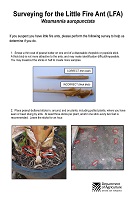
_REV.jpg "Click to view an informational flyer on how to test for Little Fire Ants")
(Click the image to view a flyer on how to test for Little Fire Ants.)
Originally published by KHON2; click here to read the article on KHON2.com.
Officials confirmed Monday the Little Fire Ant infestation in a Central Oahu neighborhood is worse than initially thought and continues to spread.
Last week, the Dept. of Agriculture said LFA was found in at least eight homes on Auina St. in Mililani Mauka.
On Monday, KHON2 spotted red flags placed in a gulch that runs alongside the street, which indicated that the state was checking to see if LFA had spread. Agriculture inspectors confirmed later in the day that they had.
However, they have yet to determine just how many additional homes across the gulch are now affected.
"We haven't finished surveying the entire area," said Rob Curtiss of HDOA. "There's a much larger area that we've identified to survey and that will take us a couple of weeks. We need to survey all those properties. We need to get permission, schedule times to enter and that will take us time."
Toni Nakamura lives on the opposite side of the gulch and told KHON2 she's worried about what will happen. "I know the repercussions of the bites can cause blindness in pets, but also coming on to the property when you want to go outside and relax, you risk getting bitten," she said.
"The state is taking point as far as identifying where the locations are and any locations they find on our property, we will partner with them," said Millilani Town Association general manager Dave O'Neal.
Officials say once inspectors finish mapping the general area, they will formulate a general plan for eradication.
State Sen. Donovan Dela Cruz and Rep. Beth Fukumoto plan to holding a town hall meeting the week of July 14 to discuss how they can work together to stop the spread of Little Fire Ants. Details have yet to be determined.
However, the state says education remains a top priority.
"The best thing to do is to educate people, to let them know why the little fire ant is a problem and what they can do to prevent it from moving around. The number one reason that little fire ant moves around is because people are moving things around."
To test for LFA, residents are instructed to use a little peanut butter on a chopstick and leave them in several areas for about one hour. Any ants collected should be put in a sealable plastic bag, placed in the freezer for 24 hours and dropped off or mailed to any HDOA office.
If you suspect LFA in your neighborhood, call the state's pest hotline at 643-PEST (7378).
An informational flyer may be downloaded here.
In addition, the Department of Land and Natural (DLNR) Resources has produced a three-minute video, "How to Test for LFA," which shows the step-by-step procedure for testing for LFA.
Originally from South America, LFA is considered among the world's worst invasive species. LFA are tiny ants, measuring 1/16-inch long and are pale orange in color. They move slowly, unlike the Tropical Fire Ant, which is established in Hawaii, move quickly, and are much larger with a larger head in proportion to its body.
LFA can produce painful stings and large red welts and may cause blindness in pets. They can build up very large colonies on the ground, in trees and other vegetation, and buildings and homes and completely overrun a property.
For updated information on LFA in Hawaii, go to the HDOA website.
 HONOLULU - The Hawaii Department of Agriculture (HDOA) has confirmed that the stinging little fire ants (LFA) have infested a Mililani Mauka neighborhood. This is the first incident of LFA in a residential area on Oahu since the ants were detected on the island in December 2013. Previous infestations have been at distributors of hapuu logs, garden shops, landscape projects, commercial nurseries and on state land near nurseries in Waimanalo.
Today, crews from HDOA, the Oahu Invasive Species Committee (OISC), U.S. Fish & Wildlife Service (FWS), Coordinating Group on Alien Species (CGAPS), surveyed homes on Auina St. using peanut butter baiting. Initial surveys indicate that at least six homes are positive for LFA. Crews also canvassed the neighborhood leaving informational flyers on how to detect and report suspected LFA infestations.
On June 18, a Mililani Mauka resident who lives on Auina St. brought ant samples to HDOA after family members reported ant bites for at least several weeks inside the home. On June 19, HDOA staff surveyed the property and found LFA in all four corners of the property. Further surveying was done on four adjacent yards and LFA was found along the property lines. Surveys did not detect LFA further into the adjacent homes. Staff immediately treated the LFA infested areas with a pesticide.
On June 23, a resident who lives three homes away from the initial infestation site submitted ant samples to HDOA saying their home had these ants for "a couple of years," along with a neighbor's home. State entomologists confirmed it was LFA and agree that, given the apparent size and scope of the infestation, LFA could have been in the neighborhood for years.
"The increasing number of homes involved is concerning," said Scott Enright, chairperson of the Hawaii Board of Agriculture. "We urge residents to take the time to check their homes and yards for this ant and report it as soon as possible."
Since the LFA detection in December, HDOA and partner agencies have been asking residents on Oahu and Maui to survey their homes. To test for LFA, residents are instructed to use a little peanut butter on a chopstick and leave them in several areas for about one hour. Any ants collected should be put in a sealable plastic bag, placed in the freezer for 24 hours and dropped off or mailed to any HDOA office. An informational flyer may be downloaded at: http://hdoa.hawaii.gov/pi/files/2014/05/LFASurvey.pdf (or, click the above image).
In addition, the Department of Land and Natural (DLNR) Resources has produced a three-minute video, "How to Test for LFA," which shows the step-by-step procedure for testing for LFA. The video is available at: https://vimeo.com/97558997
LFA has been found on Hawaii Island since 1999. In December 2013, LFA was detected on hapuu logs (Hawaiian fern) at retail stores on Maui and Oahu. Since its detection, Oahu and Maui nurseries have been surveyed. Five Oahu nurseries, three of which were in Waimanalo, were found to have small infestations of LFA, the areas were treated and are clear of the ants.
In late May, crews began treating a 6-acre area in Waimanalo, which included a 3.5 acre infestation area and buffer zone. Crews continue to conduct follow-up treatments at the Waimanalo site.
Originally from South America, LFA is considered among the world's worst invasive species.
LFA are tiny ants, measuring 1/16th inch long, are pale orange in color. LFA move slowly, unlike the Tropical Fire Ant, which is established in Hawaii, move quickly, and are much larger with a larger head in proportion to its body. LFA can produce painful stings and large red welts and may cause blindness in pets. They can build up very large colonies on the ground, in trees and other vegetation, and buildings and homes and completely overrun a property.
Suspected invasive species should be reported to the state's toll-free PEST HOTLINE – 643-PEST (7378).
For updated information on LFA in Hawaii, go to the HDOA website at: http://hdoa.hawaii.gov/pi/main/lfainfo/
 Senator Dela Cruz is proposing to situate a centralized and consolidated home for first responders in Central Oahu at Mililani Tech Park. This would be training facilities for some agencies headquarters for others, and warehouse/storage facilities. The agencies include police, fire, EMS, sheriffs, civil defense, Hawaii National Guard, and the State's data center.
Senator Dela Cruz stated that it would make a lot of sense to do this because there are four military bases nearby and a major airfield across the street. It is also out of the inundation zone.
Thus far, more than $11 million have been appropriated toward this effort. The plan is to purchase land from its current owners, Castle & Cooke, for the facility which would be situated on 150 acres of land.
Honolulu police and fire departments, EMS, Department of Public Safety and state data services support the plan. Currently, the state's computing resources are scattered in various locations and the campus would allow the consolidation and centralization of the data center and allow the sharing of resources and support services.
State Civil Defense is studying the proposal of moving its headquarters from Diamond Head to Mililani Tech Park. This centralized campus will not mean that every agency will move all of its services to this location, but for those agencies presently without a headquarters, this will offer them a location for their facilities.
In addition, this new campus has the potential of creating jobs. A timetable for this project is currently being worked on and hopefully the Governor will release the funds for the purchase of the land to allow this project to proceed.
Click here to view the June 2014Newsletter.
Originally published by KHON2; click here to read the article on KHON2.com.
Originally published by KHON2; click here to read the article on KHON2.com.
There is a bit of relief for Ewabound drivers in the Pearl City area next week.
The state won't be shutting down as many lanes as it has been during the evenings.
This week the Department of Transportation is taking a break from construction.
It postponed work on the PM Contraflow project to mull over ways to alleviate the traffic the construction has been creating.
Every weeknight, Ewabound drivers are faced with this.
"It's, you know, very difficult," said Fred Mangca, driver.
"It's pretty bad," said another driver.
After last week's mess on the roads because of two different projects, a bit of good news for drivers. Instead of closing down four lanes on the freeway when work resumes next week, the state will only shut down two lanes during the weeknights.
Officials say they had to close all four lanes for the type of work they were doing. They're hoping next week's change will help to ease the traffic, as they work to add another lane between Aiea and Waikele.
Sen. Donovan Dela Cruz shares his thoughts on whether the widening the H-1 by the Pearl City area will help alleviate traffic.
"Well, the Department has already widened sections of H-2 and H-1 already and we haven’t seen much relief," said Sen. Donovan Dela Cruz, (D) Wahiawa, Whitmore Village.
Sen. Dela Cruz says his office receives complaints about the traffic and believes the DOT isn't looking at the big picture.
"The real solution is to create jobs in the areas where people live. So that way they don't have to make the commute. They don't have to drive into town everyday," he said.
The PM Contraflow project also includes building an evening zipperlane in the Ewabound direction. It's a portion of the project the state has been talking about and planning, for years. But now the zipperlane is up in the air.
The DOT says the installation of the PM Contraflow zipperlane will be re-evaluated after the new lanes are complete. That's expected by the end of this year.
Officials say if the traffic flow improves from all the work they're doing now, then they'll hold off on building that evening zipperlane. That will save them $1 million a year in maintenance costs.
One solution could be an evening zipperlane.
"I think it would. It works in the morning, so it should work in the evenings," Mangca said.
"Nah, you're just taking up land," another driver said.
Building a zipperlane is included in the project and the signed agreement with the contractor. The state does not know how much it will cost if plans are changed, but we'll keep following up with them to see if taxpayers money, will be lost.
USDA Rural Development State Director for Hawaii and Western Pacific Chris Kanazawa today announced that USDA is accepting applications for low-interest loans to improve healthcare facilities in rural areas.
"Ensuring our rural residents have access to quality health care is a top priority for USDA," said Kanazawa. "This funding will help a variety of health clinics, hospitals and other similar facilities throughout rural Hawaii and the Western Pacific make a variety of needed improvements."
The funding is available through USDA Rural Development's Community Facilities Program. Loan funds can be used to construct, expand, or improve health care facilities, as well as purchase equipment. Public bodies, non-profit organizations and federally recognized tribes with health care facilities in rural areas and towns up to 20,000 in population are eligible to apply.
Locally, USDA Rural Development provided funding for the Maui Memorial Medical Center, Molokai Community Health Center, and Bay Clinic among others.
USDA has set a goal of investing up to $50 million to increase access to mental health care in rural areas over the next three years. USDA is also investing in innovative healthcare technologies such as telemedicine, to further expand access to health care services throughout rural America.
For more information, contact Tim O'Connell at (808) 933-8313 or tim.oconnell@hi.usda.gov.
President Obama's plan for rural America has brought about historic investment and resulted in stronger rural communities. Under the President's leadership, these investments in housing, community facilities, businesses and infrastructure have empowered rural America to continue leading the way – strengthening America's economy, small towns and rural communities.
USDA's investments in rural communities support the rural way of life that stands as the backbone of our American values. President Obama and Agriculture Secretary Vilsack are committed to a smarter use of federal resources to foster sustainable economic prosperity and ensure the government is a strong partner for businesses, entrepreneurs and working families in rural communities.
The Wahiawa Community Based Development Organization (WCBDO) is updating the Wahiawa Neighborhood Plan and your input is needed. The WCBDO developed a quick and easy online survey to help shape the Plan. This is a great opportunity to let your voice be heard as we look forward to the future.
Just 3 easy steps to take the survey:
1. Visit the webpage: www.wahiawacbdo.org
2. View homepage, then click on "take the survey now"
3. Complete survey - pau!

You can also take the survey on your smart phone by using this QR code.
The survey findings will be presented to the community on May 27, 2014 at 7:00pm at the Hale Hookipa Building in the Wahiawa District Park. Please spread the word to family and friends living or working in Wahiawa. The deadline is May 30, 2014. Mahalo!
Originally published by Honolulu Civil Beat; click here to read the article on civilbeat.com.
The Environmental Protection Agency launched a management study with the Hawaii Department of Health this week to figure out why the state has a $52 million surplus in federal funding for drinking water infrastructure projects.
Each year, the EPA gives the state about $8 million for the Drinking Water State Revolving Fund. The state matches 20 percent of the money and then issues 20-year loans to the counties at low interest rates for projects such as installing new pumps and protecting wells from contamination. But some state and federal officials are concerned the money hasn’t been flowing out to counties as quickly as it should.
The excess money is nearly a third of the total the program has received since it was established in 1997.
The surplus doesn't mean Hawaii's drinking water infrastructure is up to par. Dean Higuchi, spokesman for the EPA, said the agency's latest national survey found there is a significant need for improvements in Hawaii.
"We've identified over a billion dollars in need," Higuchi said, noting that over 90 percent of that is within the City & County of Honolulu. "It's not like there's not a need out there."
Jill Kuramoto, spokeswoman for the Honolulu Board of Water Supply, said lengthy and stringent requirements to qualify for the loans, along with limits on the agency's borrowing capacity, have slowed down efforts to utilize the funding.
Still, she said that the BWS has received $37 million from the fund since its inception and that another $19 million in loan agreements are being processed.
Gary Gill, deputy director of environmental services at the Department of Health, acknowledged the counties may be discouraged from participating in the program because of cumbersome conditions, such as a Buy American provision and record-keeping rules.
"We have been struggling for more than a decade to encourage the counties to make more use of this fund," Gill said.
He added that construction delays can cause the counties to take out loans more slowly than expected. And until recently, it was cheaper for the counties to get bond financing rather than use the program.
Despite the challenges, Gill said the state has been making progress by lowering interest rates, streamlining the loan process and increasing outreach to county officials. The state is also working with the Honolulu Board of Water Supply to refinance several projects costing tens of millions of dollars.
Their efforts are already reaping results. Thanks to lower interest rates, Kuramoto said the BWS plans to borrow another $10 million from the program in fiscal year 2014, a higher amount than past years.
She added that the BWS is establishing a 30-year plan to prioritize capital improvement projects and said the agency will continue to take advantage of the program "in a thoughtful and responsible manner that benefits our ratepayers."
Gill is optimistic that the situation is improving.
"We're projecting that the $52 million of available loan money will be drawn down and utilized in the next couple of years as we are seeing more and more projects coming online," Gill said.
While there's no time limit for the money to be spent, Higuchi said the agency is worried that Congress might redistribute it if it's not used.
"At this point, we've been pretty lucky there hasn't been a callback to pull any money back," Higuchi said.
Out of concern that the funding could evaporate, EPA officials reached out to several state lawmakers earlier this year to inform them of the situation.
Sen. Donovan Dela Cruz sent a letter to the agency last week asking for more details. The senator from Wahiawa said he wants to know whether there is anything the Legislature can do about the matter.
"Is it worth calling a special session if you're going to lose 50 million bucks? Is it something that we should do interim committee work on?" he said. "I don't know what steps to take until we get the answers."
Originally published by The Republic; click here to read the article on therepublic.com.
Hawaii lawmakers are proposing to move the state's public safety facilities to one central area that is safer from flooding.
A resolution proposed by senators Michelle Kidani and Donovan Dela Cruz would also consolidate the state's data centers from 30 sites to one. The resolution says the current data centers are poorly monitored and of low quality.
The lawmakers say the ideal site for a safety and data security campus would be a 150-acre plot in central Oahu. They say disasters such as Hurricanes Katrina and Sandy demonstrated the need to keep public safety sites far from floods and tsunamis.
The proposed site would also allow for reliable access to power, is near major roadways and offers quick access to downtown Honolulu and Honolulu International Airport.
Senators Donovan Dela Cruz and Michelle Kidani this session have proposed a resolution calling for the state to establish a public safety technology campus and cyber security command center in order to ensure access to public safety services during a natural disaster.
The resolution asks the Department of Accounting and General Service and the Chief Information Officer to look into developing a plan to relocate public safety facilities located within and nearby inundation zones to a centralized non-inundation zone area that will provide direct access to highways and be in convenient proximity to hospital and military services assistance. It also recommends changes to the current organization of Hawaii's data centers, which are not fulfilling the capacity, reliability and security needs of various departments.
"Our public safety facilities are old and located in inundation zones. We need to upgrade these facilities and move them to a central location that doesn't run the risk of flooding," said Sen. Dela Cruz. "During a major disaster like Hurricane Katrina and Sandy, the way our public safety facilities are established now, critical systems could be unavailable for months."
"Hawaii's current data center environment, comprised of 30 low quality data centers, is poorly secured, monitored and completely unstaffed 65 percent of the time exposing the state to major physical and cyber security breaches," added Kidani. "We have to do better with our technology infrastructure and build a permanent data center for heightened data security."
Recommended as a prime location for a new, consolidated public safety technology campus and cyber security command center facility is 150 acres of land for sale in central Oahu. The lands provide geographic diversity, being far enough from the coastline and in close proximity to major highways.
The data command center would include 8,000 to 10,000 square feet for a computer room with 250 racks, an electric power load of two megawatts for information technology equipment, and a tier 3 reliability rating. Ten acres would be dedicated for an innovation and research facility, 40 acres for a sheriff facility, and an unspecified number of acres for facilities housing city, state and federal public safety agencies.
Originally published by the Honolulu Star-Advertiser; click here to read the article on staradvertiser.com.
A movement to commercialize breadfruit in the isles has slowly been taking root in recent years, and a bill moving through the state Legislature aims to give a much-needed boost to the fledgling industry.
Senate Bill 3023 proposes appropriating an unspecified sum in the upcoming fiscal year for research, development and marketing of breadfruit, or ulu.
"In order to have an industry, you need to bring it to scale," said James Nakatani, executive director of Agribusiness Development Corp., which would spend the money. "Right now it's too small."
Touted as a "miracle substance" by state agriculture leaders, breadfruit has the potential to become a new food staple in Hawaii - in line with taro and rice - and blossom into a booming export industry, supporters of the bill contend.
"Breadfruit is a wonderful thing to start cooking," Sharon Hurd, an economic development specialist with the state Department of Agriculture, said in a phone interview Friday. "It steams very easily, it bakes well, you can make desserts out of it. ...It was really, really, really good."
Sen. Donovan Dela Cruz (D, Wahiawa-Whitmore-Mililani Mauka), chairman of the Senate Economic Development, Government Operations and Housing Committee, said the bill does more than just fund breadfruit research. It can help diversify Hawaii's tourism-dependent economy, promote sustainability, reduce imports, create jobs and pave the way for crops such as blueberries, tea, oranges, papaya and peaches to be developed in the state's various microclimates in a similar fashion.
"We've got to be more proactive in identifying and supporting some of these crops so we can get to the point of being commercial," Dela Cruz said. "If we can do that, then ag land will hopefully become more profitable than having the option to develop ag land."
Sen. Malama Solomon (D, Kaupulehu-Waimea-North Hilo) introduced the bill, which is poised to cross over to the House this week. Solomon's office said ulu has "unrecognized potential as an agricultural commodity," as the Senate Agriculture Committee noted in its report on the bill.
The bill states that ulu was one of the few subsistence plants Polynesians brought with them to Hawaii around 750 A.D. According to the Breadfruit Institute, founded by the National Tropical Botanical Garden in Hawaii in 2003, breadfruit originated in the South Pacific, where it has been cultivated for 3,000-plus years.
Breadfruit is naturally gluten-free, which lawmakers believe positions it to fit into the growing U.S. market of gluten-free products, which is estimated to generate at least $6.6 billion by 2017. Lawmakers envision Hawaii as the Pacific headquarters for refining, processing, packaging and exporting ulu products - such as gluten-free noodles made with ulu flour - to the mainland, with U.S. Pacific territories serving as subregional hubs.
Support for the bill has also come from the Association of Hawaiian Civic Clubs. Soulee Stroud, the association's president, said in written testimony to the Senate Ways and Means Committee that the marketing of breadfruit is in line with efforts to preserve and perpetuating Native Hawaiian culture.
Stroud said decreased access to ulu over the past century has caused "urban Hawaiians" to "lose the taste and benefits of this staple so familiar to the kupuna," but younger Hawaiians are starting to take interest in the fruit by sharing recipes.
"We would ask, however, that the original Hawaiian ‘ulu not be lost in the proliferation of Polynesian varieties," he wrote.
The state Senate is working on a number of bills that could have major effects on our community. Here are a few:
Senate Bill 2400 requires the Agribusiness Development Corporation (ADC) and the University of Hawaii College of Tropical Agriculture and Human Resources (CTAHR) to design a program that would create new farmers by identifying emerging crops and productive uses for lands managed by the ADC.
The intent is to design a program to prepare the cultivation of these lands.
The bill also requires the Department of Agriculture and ADC to develop a coordinated land management strategy to promote diversified agriculture, support emerging and specialty crops and enhance the development of agriculture.
These organizations also would be required to coordinate and provide technical support to farmers in identifying emerging and promising crops, and their efforts to cultivate a successful agricultural business.
We have acres of potentially productive lands that are currently lying fallow. We need to make these lands productive again, and with it the emergence of diversified agriculture.
Further, for agriculture to succeed, we need to help farmers by enabling them to succeed with their operations. We cannot just talk about our need to reduce our dependency on imported food. We need to make it happen.
Senate Bill 2434 creates a full-time position to assist the Alzheimer’s disease and dementia services coordinator in the Executive Office on Aging with information and referrals, counseling, education, support groups and safety services.
Realizing that many families have had, or are now coping with, family members who have Alzheimer’s disease or dementia, I introduced the bill to enable the office to work toward achieving the following goals:
• To prevent and effectively treat Alzheimer’s disease;
• To enhance the quality and efficiency of care;
• To expand support for people with Alzheimer’s disease and their families;
• To enhance public awareness and engagement; and
• To improve data to track progress
Families and caregivers need support to help their loved ones, and to address the demands of day-to-day care and the need to be able to seek services and help to develop a good support system to enable them to deal with their situations.
For more information about these bills or to contact Sen. Dela Cruz about issues important to you, call 586-6090 or email sendelacruz@capitol.hawaii.gov.
Originally published by MidWeek; click here to read the article on midweek.com.
State senators have introduced land exchange legislation that they say will help protect agricultural and conservation lands, while boosting the agriculture industry in Hawaii.
The measure is being supported by 18 state senators, including the bill’s main sponsor Donovan Dela Cruz.
The bill has passed a second reading and has been referred to the Ways and Means Committee.
Senate Bill 3065, Relating to Land Exchange, would allow the Department of Land and Natural Resources to exchange state-owned parcels in Kapolei for 20,000 acres of agricultural and conservation lands in Central Oahu. The lands, owned by the Castle & Cooke, surround the 1,207 acres of arable land purchased by the state for $13 million in 2012.
The land acquisition was part of the Whitmore Project, an initiative hoping to revitalize Hawaii's agriculture industry by bringing farmers and the state together to increase food production, create jobs and provide affordable housing.
Castle & Cooke has listed the land for sale at $175 million and supports the idea of an exchange. The state owns land near areas where transit-oriented development is in the works.
"A land exchange with Castle & Cooke makes real sense here," stated Dela Cruz in a release. "We have to look at all our options and think outside the box to help diversify Hawaii's ag industry and preserve our lands. The state would spend little to no taxpayer money, and the exchange would allow for the appropriate entity to oversee smart development around transit plans, and put the state in a place where it can provide opportunities for farmers and preserve lands."
Originally published by Honolulu Civil Beat; click here to read the article on civilbeat.com.
WAHIAWA, OAHU - For many Hawaii residents, the rural town of Wahiawa in central Oahu is just a place you drive through when traveling to the beaches on the North Shore or commuting to urban Honolulu.
Fast food restaurants line the small stretch of Kamehameha Highway that snakes through the town. Cars heading north are greeted by signs advertising a pawnshop and several chain stores.
Time has changed Wahiawa. It was long surrounded by Hawaii's prosperous pineapple plantations, which were one of the state’s main economic motors for most of the 20th century.
Decades later, the town's farming character has faded. Fields lay fallow, unused farm equipment gathers rust and the elements are chipping away at old barn roofs. Wahiawa residents say crime has gotten worse and young adults are leaving town in search of opportunity.
But Sen. Donovan Dela Cruz is hoping to change all that.
If You Build It...
The 40-year-old Dela Cruz has only been in the Senate since 2011. But he’s introduced a slew of bills this year aimed at restoring the area by improving food production around his hometown, and they’re gaining traction.
When the lawmaker talks about the need for jobs in the area, he speaks with urgency.
"When I was a kid, the place was booming," he said, describing the fields that are languishing.
The town was once at the center of the state's pineapple industry. Wahiawa is where James Dole started the Hawaiian Pineapple Company in 1901.
But the last sugar mill in neighboring Waialua closed in 1996. Today, Dole Plantation is more of a tourist stop than any sort of major economic force. That demise reflects the statewide reality that Hawaii's agricultural economy is very small and shrinking.
In Wahiawa, residents tend to earn less and are more likely to live below the poverty line than the average person in the state. Dela Cruz compares what happened in the town with the impact of the decline of the coal and auto industries on cities that relied on them.
It wasn’t just the jobs that were lost, Dela Cruz said, it was the sense of community.
He introduced six bills this session to help catalyze the area's farm economy and help transform Wahiawa into an agricultural business hub.
The measure that has garnered the most attention is Senate Bill 3065, which would allow the state to trade land slated for development in Kapolei in exchange for agricultural land owned by the Dole Plantation.
Much of that land is designated for conservation but Dela Cruz wants to hand over 6,000 acres of farmland to the Agriculture Development Corp., the development arm of the state Department of Agriculture, so that the agency can offer long-term leases to Hawaii farmers and spur local food production.
The state imports around 90 percent of its food and has pledged to improve food security.
Other measures, like Senate Bill 2020, aim to promote farming by designating a foreign trade zone in the area to help farmers lower their overhead costs. Sen. Dela Cruz is also pushing Senate Bill 2400, which would create a new program in conjunction with the university to help train new farmers and Senate Bill 2397, which would establish an agricultural technology park.
The senator is also advocating for non-agricultural measures to help improve the town's economy. Senate Bill 2399 aims to make Wahiawa a center for geriatric research and Senate Bill 3066 would create an agency to facilitate public-private partnerships, starting with a single pilot project in Wahiawa.
Originally published by Honolulu Civil Beat; click here to read the article on civilbeat.com.
A national college scholarship for Hispanic public high school students who live in districts represented by Hispanic legislators is now accepting applications.
Sens. Donovan Dela Cruz and Michelle Kidani, who are both of Hispanic descent, are encouraging high schoolers in their districts to apply for the scholarships, which will be awarded to 11 students total.
Dela Cruz represents the district including Mililani Mauka, Waipio Acres and Wahiawa, while Kidani represents the district including Mililani Town, Waikele and a portion of Waipio Gentry.
The scholarships are worth $3,000 each and are earmarked for juniors and seniors who are Hispanic or of Hispanic descent. Recipients must be U.S. residents and have a 3.0 GPA or higher. A Hawaii applicant must be enrolled in a high school in either Dela Cruz or Kidani's district and have a nomination from a principal, teacher, counselor or lawmaker.
Click here for more info on the National Hispanic Caucus of State Legislators’ John S. Martinez Leadership Scholarship.
The National Hispanic Caucus of State Legislators (NHCSL) announced that they are now accepting applications for the John S. Martinez Leadership Scholarship. NHCSL will award scholarships to eleven Hispanic public high school students that reside in the district of a Hispanic State Legislator.
Senators Donovan Dela Cruz (District 22 - Mililani Mauka, Waipi‘o Acres, Wheeler, Wahiawa, Whitmore Village, portion of Poamoho) and Michelle Kidani (District 18 - Mililani Town, portion of Waipi‘o Gentry, Waikele, Village Park, Royal Kunia), both of Hispanic descent, are encouraging students living in their districts to apply. Each recipient will be awarded a one-time $3,000 scholarship upon graduating high school and admittance into a college or university. They will also have an opportunity to meet their lawmaker and be recognized in the community for educational excellence.
"We have a plethora of promising leaders attending our Hawaii high schools," said Sen. Kidani. "They diligently work hard day after day on their studies while participating in a variety of extra-curricular activities including giving back to their community."
"Everyone should be afforded the opportunity for higher education, and scholarships like this make it possible," added Sen. Dela Cruz. "This scholarship gives students the resources necessary to achieve their academic goals. We encourage all junior and senior students who meet the requirements and are attending high school in our districts to submit an application."
To be eligible for the NHCSL John S. Martinez Leadership Scholarship, each student must be Hispanic or of Hispanic descent, a U.S. legal resident, have a 3.0 or higher grade point average, a junior or senior enrolled in a high school in Senate District 18 or 22, nominated by the school principal, teacher, guidance counselor or lawmaker, and submit an application packet.
For more information and/or to submit an application, students should visit www.nhcsl.org. The deadline for applications is March 15, 2014.
Originally published by Honolulu Civil Beat; click here to read the article on civilbeat.com.
Three Senate panels voted on Tuesday to move forward a bill to exchange state land in West Oahu with private agricultural land in central Oahu.
Sen. Donovan Dela Cruz has been advocating for the measure, Senate Bill 3065, as a way to preserve Hawaii's farmland and help transform the rural town of Wahiawa into an agribusiness hub.
Because of constitutional issues brought up by the state attorney general, the senators amended the measure and took out language specifying exactly what land in Kapolei the state would give up.
The new version simply sets aside money for the state Dept. of Budget and Finance to conduct the land switch with Dole Food Company, Inc.
Another measure, Senate Bill 112, creates a special fund to help pay for the deal if the state’s property in West Oahu falls short of the value of Dole’s land, which is on the market for $175 million.
The bill goes next to the Senate Committee on Ways and Means.
Originally published by Honolulu Civil Beat; click here to read the article on civilbeat.com.
Hawaii Sen. Donovan Dela Cruz really likes the idea of public-private partnerships.
The senator wants the Legislature to create an organization called the Public-Private Finance Initiative that would facilitate partnerships between the state and private businesses with the aim of improving state facilities.
But it's a risky move given the intense public criticism Dela Cruz has received over the last couple of years after pushing for the creation of the Public Land Development Corp. (PLDC).
The Legislature established the PLDC in 2011 to develop state land through private-public partnerships, but the agency was abolished last year after county leaders, environmental organizations and many residents balked at the organization’s zoning exemptions and perceived lack of accountability.
Dela Cruz tried again last year to get the Legislature to create an organization called the Public-Private Partnership Authority.
The agency would have been limited to four initial projects, but the bill was lambasted as too similar to the PLDC and ended up dying in conference committee. Because the Legislature has a biennial session, the proposal could be reconsidered this year.
Dela Cruz’s latest idea for a Public-Private Finance Initiative would create a new agency that would be limited to a single project in Dela Cruz's district, Wahiawa.
Dela Cruz said he recognizes the bill might be haunted by the public's suspicion of the now-defunct PLDC, but thinks this new, more limited organization could go a long way to making effective use of state land and coordinating amongst state agencies.
"What we're talking about with this bill is a pilot project so that people can be more comfortable with the idea [of public-private partnerships]," he said.
The proposal, Senate Bill 3066, is scheduled to be heard by two committees on Monday.
Originally published by Honolulu Civil Beat; click here to read the article on civilbeat.com.
Sen. Donovan Dela Cruz has introduced two bills to spur the state to strategize the best ways to develop its land around Honolulu's planned rail line.
The city has been spearheading plans for transit-oriented development but Dela Cruz said the state should be involved too because it owns more land around the planned rail stations than any other entity.
He said the state should look at rail line from the perspective of a landowner and consider how its nearby property could be used to provide housing and generate revenue.
"How are we leveraging this $5 billion investment of rail to achieve our other initiatives?" he said. "I'm not quite sure why we're not having this discussion."
Three Senate committees plan to meet to consider Dela Cruz’s proposals on Monday.
Senate Bill 2436 creates an advisory committee made up of planners, architects, state and city officials, cultural specialists, community members and others to make recommendations about "sustainable development" near rail stations.
Senate Bill 2437 creates working groups in state agencies to figure out how state land around rail stations could be used to help the economy and provide more housing for Hawaii's workforce.
 Dementia is the progressive decline of a person's cognitive abilities of which Alzheimer's disease is the most common type. Due to the inevitable aging of the Hawaii population, the prevalence of age-related illness, including Alzheimer's disease, is expected to increase. By 2015, the Hawaii population over the age of 65 will increase by 67 percent. The Alzheimer's Association has projected that in 2025, there will be 34,000, or 10 percent, of Hawaii residents age 65 and older diagnosed with Alzheimer's disease.
This session, I've introduced legislation that seek to establish within the executive office on aging an Alzheimer's disease and related dementia services coordinator to coordinate the provision of public and private Alzheimer's disease and related dementia services.
This program will expand support for people with Alzheimer's disease and their families by providing the following services: a family consultant with expertise in dementia care to provide in-home needs assessment, counseling, information, and assistance with care decisions; Assistance for caregivers of individuals with Alzheimer's disease and related dementia in finding and selecting the type of respite and support services that best meets their needs; Funding assistance when available for those who qualify for support of in-home personal care, adult day services, group respite, or overnight residential respite care for eligible families; Training and educational resources for family caregivers, respite care providers, and community organizations; and linkage to community based agencies and the Alzheimer's Association – Aloha Chapter.
Click here to view the January 2014 Newsletter.
Originally published by Honolulu Civil Beat; click here to read the article on civilbeat.com.
Hawaii lawmakers have proposed a number of bills this year aimed at making sure Hawaii is better prepared to deal with a toxic spill in the wake of the September molasses leak at Honolulu Harbor that killed thousands of fish and devastated coral reefs.
A ruptured pipeline caused a quarter million gallons of molasses to spill into the harbor, sparking intense public scrutiny of Matson shipping company as well as state agencies charged with regulating the harbor, in particular the Hawaii Department of Transportation.
The U.S. Environmental Protection Agency and Hawaii Department of Health are currently investigating the spill. And Matson was served with a federal grand jury subpoena in October for documents relating to the accident.
In the meantime, lawmakers say that their bills will improve the state's emergency response plans, as well as tighten the reporting and oversight responsibilities of state agencies involved in marine spills.
"While the investigation continues, here are some concrete steps we can take to make sure this doesn't happen again," said Rep. Chris Lee, chairman of the House Energy and Environmental Protection Committee, who has proposed three bills relating to the spill.
Response to Matson Spill Lacking
It's been nearly two decades since Hawaii came up with a plan to address hazardous spills, according a bill jointly proposed by Lee and Sen. Mike Gabbard, chairman of the Senate Energy and Environment Committee. And that plan only deals with oil spills, not the medley of other substances that are transported in and out of Hawaii's harbors, such as molasses.
Health officials blamed the relatively slow response to the Honolulu Harbor disaster on the fact that Hawaii had no response plan for molasses.
House Bill 2621, contracts between state agencies and lessees would specify a strict timeframe under which such problems must be communicated.
Another bill, introduced by Sen. Donovan Dela Cruz, would ensure that operators such as Matson pay for all damages caused by toxic spills. In past months, Matson representatives have said that the company will pay for the molasses cleanup effort, but haven't committed to covering long-term environmental damages.
Senate Bill 2018 specifies that parties "have unlimited liability for all damages resulting from any spill or incurred by the state in responding to a release or threatened release of oil, hazardous substances, or unnatural or artificial substances."
"It's just trying to make sure that whoever creates the disaster, that they make sure they pay for all of it and that the state or taxpayers are not going to be on the hook for someone else's mistake," said Dela Cruz.
Conspicuously missing from this year's proposals are bills seeking significant changes at the transportation department, which struggled in the aftermath of the molasses spill to respond to media questions regarding its oversight responsibilities of the harbor.
House Transportation Committee Chair Ryan Yamane could not be reached for comment, while Sen. Kalani English, chair of the Senate's Transportation and International Affairs Committee, said that he didn't intend to introduce any bills related to the transportation department.
English said that he wanted to wait for the investigations to conclude first. "If you are jumping into a black hole, you want to know what is in the hole," he said.
Originally published by The Honolulu Star-Advertiser; click here to read the article on StarAdvertiser.com.
In a creative land swap, the state would trade about 925 acres near the planned East Kapo¬lei rail station to Castle & Cooke for redevelopment in return for some 20,000 acres of Dole Food Co. land between Wahiawa and the North Shore that would be preserved for agriculture and conservation.
State Sen. Donovan Dela Cruz, who is proposing the land exchange, contends it would help achieve the transit-oriented development necessary for the success of the Honolulu rail project and advance the state’s interest in protecting agriculture and open space from urban encroachment.
The Abercrombie administration has separately been working with the Trust for Public Land and a renewable energy developer on a more conventional $175 million purchase of the Dole land. The state had worked with public and private interests in December 2012 to acquire more than 1,700 acres of nearby Galbraith Estate land.
Saving beachfront property near Kawela Bay and Kahuku Point from development by Turtle Bay Resort has captured the hearts of the past two governors and the North Shore conservation movement. But the Dole land is far larger in acreage and potentially far more important to preserving agriculture and preventing urban sprawl.
"If the state doesn't take an active role in making sure that it stays in conservation, we could be at risk of it being piecemealed out to private developers or private landowners," said Dela Cruz (D, Wheeler-Wahiawa-Schofield), chairman of the Senate Economic Development, Government Operations and Housing Committee.
Garret Matsunami, director of engineering and site construction at Castle & Cooke, which shares the same owner — billionaire David Murdock — as Dole Food Co., said he is still reviewing a draft of Dela Cruz's bill proposing the swap.
"We're definitely looking forward to seeing how this goes," he said.
Dela Cruz's bill would establish an East Kapolei Community Development District, which could help ease redevelopment around the planned rail station if the roughly 925 acres of state land is acquired by Castle & Cooke. The East Kapolei station is the first along the 20-mile rail line to Ala Moana Center and is in the heart of a region already primed for development.
The bill would also create a Whitmore Project special fund that would hold the proceeds of revenue bond sales that might be used to help purchase the Dole land. The value of the state land around the East Kapolei rail station might not be enough to match the Dole land, so the state could use revenue bonds to help finance the acquisition.
The state budget already contains an authorization for $175 million in revenue bonds to potentially purchase the Dole land, but the bonds are in limbo after a squabble last year between Dela Cruz and state Rep. Jessica Wooley (D, Kahaluu-Ahuimanu-Kaneohe), chairwoman of the House Agriculture Committee, prevented the creation of a fund to handle the bond money.
State Rep. Sylvia Luke (D, Punchbowl-Pauoa-Nuuanu), chairwoman of the House Finance Committee, who spoke with Dela Cruz about his bill Friday, said the state needs to take a more proactive role in identifying state land near all of the planned rail stations for potential redevelopment.
Luke said she would prefer an overall plan involving discussions with the city, community groups and residents, rather than dealing with just one or two rail stations.
"It needs to be a long view because this is something that’s going to impact planning for the next decade," she said.
Blake Oshiro, Gov. Neil Abercrombie's deputy chief of staff, said the governor's supplemental budget request asks lawmakers for $40 million in bond money to acquire prime agricultural land and $10 million in bond money to purchase conservation land in Central Oahu and the North Shore area.
The Trust for Public Land has said it is working with the state and a renewable energy developer on the purchase of the Dole land over the next three to five years.
According to one presentation by the trust, about 6,000 acres could be leased for farming and ranching, and about 9,000 acres could be managed for recreation, hiking, hunting and watershed and species protection. The renewable energy developer, according to the trust, would use a portion of one parcel for a large solar energy project.
The trust has warned that the Dole land, which is near the urban growth boundary, "is the next logical target for development."
"This is really keeping the country country," Lea Hong, state director of the Trust for Public Land, said of the conservation effort.
Originally published by The Honolulu Star-Advertiser; click here to read the article on StarAdvertiser.com.
Ground-floor supporters of a potentially historic community project, about 120 people gathered at Christ United Methodist Church on Saturday to share their visions for a future Koreatown in Honolulu.
The public meeting, a follow-up to a concurrent resolution from the 2012 Legislature calling for the formulation of a master plan to guide the development of a Koreatown in the Keeaumoku area, was hosted by the state Office of Planning and attended mainly by members of local Korean business and community groups.
 Aloha,
A series of community recycling events at different Oahu sites, up to two per month. On Saturday, November 9, Ka‘ala Elementary School will host the 41st Going Green Day on the school's campus.
Accepted items include: scrap metal, one TV per car, computers, printers, scanners, cellphones, printer cartridges, PDAs, etc.; HI-5 beverage containers, used eyeglasses and hearing aids, incandescent light bulbs in exchange for CFLs, prom dresses, women’s business suits and accessories, pet food, towels and blankets; white socks for Afghanistan, residential used cooking oil, and canned goods for Hawaii Food Bank.
Document shredding available at specific events (see calendar). First box free, $10 charge for each of the second and third boxes.
Large recyclable items will also be accepted. For more information on accepted items and curbside pick-up call: Rene Mansho @ 291-6151.
All proceeds will go to Ka‘ala Elementary School. Please show your support by participating and recycling.
Mahalo
Click here to view the flyer.
It’s a common sight on the H-2 Freeway — bumper-to-bumper in the shoulder lane as drivers try to take the Wahiawa exit.
“Traffic is just getting worse and worse,” one driver said.
“Sometimes it’s pretty annoying because it’s such a small town, so it shouldn’t be that much traffic at that place,” Wahiawa resident Sam Lamberth said.
“We also see traffic during the down season, in the sense that where when the military is deployed, the traffic still exists because of the amount of people who go to the North Shore,” said Sen. Donovan Dela Cruz (D) Wahiawa, Mililani Mauka.
The state is planning to restripe part of Kamehameha Highway. A lane would be added near Lake Wilson giving drivers three lanes heading north until Olive Avenue.
“Ooh, I love that extra lane,” a driver said.
Restriping part of the highway means getting rid of some on-street parking stalls. But Sen. Dela Cruz says that’s okay because there’s a public parking lot just a block away.
The state is also looking to remove a crosswalk on the highway at Olive Street, hoping to relieve some of the congestion there.
Residents say there’s usually a line of cars waiting to get on the highway because pedestrians are crossing.
“It’s not going to impede pedestrian traffic at all, but it will allow vehicle traffic to move a lot smoother,” Sen. Dela Cruz said.
But some residents are concerned about pedestrian safety.
“Because of familiarity how to get across the street, this is where they’ve done it. Where do they go from here? And they might just cross anyway,” Wahiawa resident David Lanz said.
The Department of Transportation says this project is in the preliminary stages and road work could start next summer.
But the work could just take a few days to complete.
Read More on www.khon2.com
 The Hawaii state DOT is working hard to improve our aging highway infrastructure. Major projects are currently underway and in various stages of planning and design. Please use their Roadwork Website as a resource to help you know before you go. Scheduled roadwork that will require lane closures on state highways are listed here and are updated every Friday. For live, real-time traffic information on Oahu's major arteries go to GoAkamai.org.
Approximately two weeks before construction starts DOT plans to have a project specific website and motorist hotline number. At that time you will find a link to it from their state DOT website at hidot.hawaii.gov. Lane closure information will also be sent out weekly in their roadwork news releases to the media and legislators.
Currently the contractor is still working on the lane closure schedule and more information will be available closer to the start of work.
I appreciate your patience during hours of construction. Should you have any questions or inquiring about updates please don't hesitate to contact my office at 586-6090.
Mahalo!
Click here for more information.
Originally written by Malia Zimmerman and published by Hawai‘i Free Press; click here to read the article on HawaiiFreePress.com.
WAIKIKI - Godzilla is stomping through the streets of Waikiki, Hawaii's prime tourist hub, as Legendary Pictures and Warner Bros. put the final touches on the American-made reboot of the classic daikaiju eiga, set to be released in May 2014.
The oversized, fire-breathing "King of the monsters" may be a little less cranky when he learns that Hawaii lawmakers passed legislation, approved by Gov. Neil Abercrombie, which ups the percentage of tax credits motion picture productions can claim when filming here.
As of July 1, Hawaii has a new, expanded production tax credit, which grants motion pictures, digital media and film productions, an income tax credit of 20-25 percent.
Productions that qualify can claim tax credits equal to 20 percent of production costs from the island of Oahu, and 25 percent on neighbor islands including Hawaii Island, Kauai, Lanai, Maui and Molokai. That is an increase over last year of 5 percent for each category.
Act 88 and Act 89 also boost the credit cap from $8 million to $15 million per production and qualify productions with Internet-only distribution. In addition, state and county location and facilities fees are now qualified expenditures.
Hollywood producers have been aggressively lobbying lawmakers for the increase to the film tax credits for at least the past four years. The industry brought $400 million into the economy in 2012, with $245 million in direct spending and creating 2,500 jobs, state film office officials say.
The economic impact is likely to increase with the television production of Hawaii 5-0 in its fourth season, and films like Jurassic Park 4, Deep Tiki, Pirates of the Caribbean (part 5) and Angelina Jolie's film, Unbroken, being filmed here.
Donovan Dela Cruz, chairman of the Hawaii State Senate's Economic Development Committee, said he isn't a fan of giving away "free money", but agreed to the legislation because he said he wants to see the industry develop and not "move backward."
Dela Cruz said Hawaii needs a long-term strategy to develop the industry by syncing the education system at the high school and college level with the industry base.
He said he'd like to see the students go through the award-winning Sea Rider Film Production program at Waianae High School be able to attend a film production program at the University of Hawaii and secure a job in the film industry here.
But, he has another idea. He said he would like to see a public-private partnership where the state invests in building a film school at the university's West Oahu campus and a larger film studio for the industry on Oahu, as well as housing for the workforce - all within a 1-mile radius.
The privately-owned Maui Film Studios LLC in Kahului, Maui, already opened its 21,000-square-foot facility in March. Hawaii Island also will open Lokahi Studios, a sound stage and production house that includes a 30,000-square-foot center, concert hall and cinema. Oahu's Diamond Head facility is too cramped, Dela Cruz said.
Dela Cruz is critical of the Hawaii Film Office, a state agency charged with helping film and television productions get the permits and locations they need to film in the state.
The film office also should be developing a long-term plan that helps diversify Hawaii's economy, reverse the brain-drain and create jobs, Dela Cruz said.
The Democrat said like to see Hawaii be the "Hollywood of the Pacific."
However, if there isn't a long-term plan put in place soon, Dela Cruz said the film credit should be revoked until one can be developed with the industry. The credits will sunset in 2018 unless lawmakers renew them at that time.
State Rep. Tom Brower, D-Waikiki, hasn't seen Godzilla in his district yet, even though the monster is filming nearby, and some would say, hard to miss.
But he said he is in favor of the monster stomping through his district and getting tax credits to boot.
Brower, who serves on the House Tourism and Economic Development committees, said people in the film industry have told him that while Hawaii now has a movie or two and a television show filming here at any given time, the state could become much busier with the new tax credit incentives.
The credit will make Hawaii more competitive with other states, he said, and help build the industry.
Brower said his only disappointment in the legislation is that it offered productions that film on neighbor islands a 5 percent higher tax credit than on Oahu. He said he would have like to see the credit evenly distributed at 20 percent.
He'd also like to see a better way to track the benefits that the credit brings to the state.
Lawmakers wowed by celebrity, critic says
While House Speaker Joe Souki touts the film credit legislation as a top accomplishment during the 2013 legislative session, not everyone says the film tax credits are good for Hawaii or the taxpayers.
Lowell Kalapa, president of the Tax Foundation of Hawaii, has been an outspoken critic of the tax credit, and said he's watched lawmakers be wooed by Hollywood celebrities into giving taxpayer money away.
"Lawmakers fail to mention that in order to give away these goodies, Hawaii remains in the top 10 percent of states with the heaviest per-capita tax burden, with one of the most onerous sales tax among those states that impose a sales tax, albeit at a misleading low rate of 4 percent," Kalapa said.
"Hawaii also has the distinct honor of having one of the highest personal income tax rates, surpassed only by California," Kalapa said.
Because Hawaii is such a small state highly reliant on capital from the outside through tourism and federal defense dollars, Kalapa said the state's heavy tax burden makes it difficult for families to survive and for new business activity to develop.
"The advocates of those tax incentives argue that is the goal that they are trying to achieve - creating jobs. But then again, one has to ask, at what price?" Kalapa said.
"There is no doubt that lawmakers need to take a close look at how they are using their constituents' hard-earned tax dollars," he said. "And they are using those tax dollars when they hand out tax credits to favored groups as tax credits are just another way of spending tax dollars."
Lieutenant Governor Shan Tsutsui signed into law today two measures aimed at supporting the development of Hawaii's innovation economy and growing our State's research industry.
House Bill 858, relating to the HI Growth Initiative, appropriates $6,000,000 to the Hawaii Strategic Development Corporation to implement the HI Growth Initiative. The initiative is an investment program to develop and promote the creation of competitive high-growth companies in Hawaii.
"In order for Hawaii to thrive in today's economic landscape it is imperative that we make strategic investments now, so that we can build an innovative economy capable of carrying us well into the future," said Senator Donovan M. Dela Cruz, who chairs the Senate Committee on Economic Development, Government Operations and Housing. "This initiative provides the tools necessary to support high-growth entrepreneurial companies in State, helping us to create more high-wage jobs and remain globally competitive."
Senate Bill 1349, relating to economic development, reenacts the tax credit for qualified high technology research activities for six years. The measure also establishes new reporting requirements. Additionally, it requires DBEDT to conduct studies to measure the effectiveness of the tax credit and submit reports to the legislature.
"Hawaii's lack of career opportunities in STEM related fields has led to an exodus of many of our Island's talented youth, who are faced with too few career prospects here home," said Dela Cruz, who introduced the measure. "By reestablishing the qualified research activities tax credit this measure allows Hawaii's research and development companies to remain competitive with mainland businesses and generate and sustain lucrative high technology jobs for our children."
Senator Dela Cruz also expressed when implementing such programs involving appropriations or tax credits that they need to center around location specific economic development, targeting where the funding will be focused on to spur economic activity, so that our local people can see the progress and positive impacts within their communities.
View the media release.
Governor Neil Abercrombie signed into law today a measure aimed at helping the State of Hawaii achieve its clean energy goals by establishing a green infrastructure financing program.
Senate Bill 1087 provides a lower cost financing alternative for Hawaii businesses and residents to utilize green infrastructure equipment and technology to reduce electricity consumption by leveraging clean energy technology.
"Building Hawaii's clean energy infrastructure at a rate which is affordable for consumers is an essential component in advancing the State's clean energy initiatives," said Senator Donovan M. Dela Cruz, who chairs the Senate Committee on Economic Development, Government Operations and Housing. "We needed to find ways for all of Hawaii's consumers to benefit from affordable and clean energy options to gain relief from high monthly electric bills. This program establishes an alternative financing method that will ultimately pass savings onto the consumer by providing low-cost financing to enable the installation of green infrastructure equipment. It brings accessible and affordable energy options to all of Hawaii's individuals, working families, and small businesses. This is about reducing the cost of living and improving quality of life right here at home."
The innovative financing method created in this measure will provide a secure financing structure to allow the Department of Business, Economic Development, and Tourism to issue revenue bonds at very competitive rates, which these savings can be passed on to the consumers in the form of lower borrowing costs.
View the media release.
Originally published by The Honolulu Star-Advertiser; click here to read the article on StarAdvertiser.com.
Burned by high-technology tax incentives that many tax policy experts thought were too generous and ripe for abuse, state lawmakers have chosen to resurrect a pared-down research and development credit to reward scientific experimentation.
The 20 percent income tax credit would apply to research spending from 2013 through 2019 and would cost the state about $3.2 million a year. Companies would have to claim a similar federal tax credit to qualify and would have to increase research spending over time to enjoy the full amount.
Companies that take advantage of the tax credit would also have to file detailed annual surveys with the state Department of Business, Economic Development and Tourism so the state can track the effects on job creation, new patents or intellectual property and commercial applications.
High-tech tax incentives, which included a research and development credit, cost the state $1 billion through the past decade and were criticized by the state auditor and tax policy experts as deficient. The auditor concluded in a report last year that the state was unable to measure or ensure the effectiveness of the credits, which ran from 1999 through 2010.
Patrick Sullivan, founder and chairman of Oceanit, a science and engineering firm, said the revived research and development tax credit would be so limited that it is largely a symbolic gesture. But he and others believe it is worth starting with something smaller in scope, given how the last high-tech tax incentives were perceived.
"What we're really trying to do is restart a conversation in the state on why the tech industry and R&D is important for the state long term," Sullivan said.
Lawmakers still believe tax credits, even smaller ones, can be catalysts for innovation and economic diversity that might help the state's economy grow and reverse the "brain drain" of science, technology, engineering and mathematics talent to the mainland. Gov. Neil Abercrombie is likely to allow the credit in Senate Bill 1349 to become law.
Sen. Donovan Dela Cruz (D, Wheeler-Wahiawa-Schofield), the bill's sponsor, said he is not necessarily a huge fan of tax credits and would prefer a more comprehensive plan for economic diversification. But he believes the incentive is consistent with the "live, work, play" theme the state wants to nurture.
"Whatever we can do to try to make Hawaii an attractive place to do business for research and development," he said.
Rep. Isaac Choy D, Manoa-Punahou-Moiliili), an accountant and a former chairman of the Tax Review Commission who has become a resource for other lawmakers on tax policy, said the state's previous research and development tax credit was too generous.
Choy said the intent behind the federal tax credit is to provide an incentive for companies to increase research spending, not to award tax breaks for base amounts of research spending from previous years, as the old state tax credit did. He acknowledged that aligning the state's tax credit to the federal tax code will significantly limit the potential tax break.
"It's better than a poke in the eye," he said.
Lowell Kalapa, president of the Tax Foundation of Hawaii, questions whether Hawaii has sufficient talent in the academic and high-tech sectors to take advantage of such tax incentives. "Before you put the cart and fill it up with gold, make sure you've got a horse to pull it," he said.
Kalapa has told lawmakers that using tax credits as incentives for targeted economic growth is often poor policy, mostly because the effectiveness of such incentives has been difficult to document.
The two tax credits that survived last session were the expansion of film production tax credits - which he attributes to Hollywood allure - and the research and development tax credit, "which basically nobody really understands."
But many investors, entrepreneurs and executives in the state's burgeoning high-tech industry have defended tax credits during the past decade as important seeds of economic diversification.
Without new incentives, many argue, a high-tech industry may never fully bloom.
"It allows us the ability to bring in talent and a strong labor pool back to the state. It makes us more competitive," said Martin Kao, president of Navatek Ltd., a research and development company for military and commercial operations.
Kao had wanted lawmakers to apply the research and development credit annually to all qualified research expenses - and not just the increases in spending over the base amounts from previous years - warning that many companies may not be able to qualify.
But Kao appreciates that a credit might be revived. "It troubled me personally where we didn't have a state that kind of acknowledged the notion that what we're trying to do is bring jobs back to Hawaii," he said.
James Karins, president of Puko‘a Scientific, which develops image-processing software, said other states are making stronger pushes to attract research and development. He said a limited tax credit in Hawaii could be toughest on smaller companies that can take years to develop resources to finance research.
"Certainly anything is better than nothing," he said.
My name is Mahealani and I am Miss Hawai‘i Jr High School America 2013. I am entering 8th grade at American Renaissance Academy, and will be representing Hawai‘i in Orlando, Florida this July. We are a month away from the National Pageant and we are all very excited.
I completed my 7th grade year at ARA on the Honor Roll and Dean's List with a 3.95 GPA. I have been working with such great organizations as The Children's Miracle Network, Make A Wish Foundation, American Red Cross, American Heart Association, Pinwheels for Prevention and the Teddy Bear Drive just to name a few. I have also continued my work with the homeless shelter and Hawaii Literacy Foundation.
Recently, I have just finished writing and illustrating my first children's book called "It's Okay to Be Different" which is being published by Watermark Publishing and soon to be released!
I am also continuing to bring awareness to the bullying problem with my pageant's platform, The Crown C.A.R.E.S, and even had the honor of meeting with Governor Neil Abercrombie and sharing with him the importance of bringing awareness to Hawai‘i's youth regarding the bullying problem.
I was also so very honored to have been asked to sing Hawai‘i Pono‘i on the steps of Iolani Palace and at the Friends for the Natatorium 25th year celebration and to be a part of the King Kamehameha Day Parade.
On June 13, 2013 I was presented with the Gold Level President's Volunteer Service Award by Lieutenant Governor Shan S. Tsutsui and was also given an award of recognition by the Senate by Senator Donovan Dela Cruz.
On June 14, 2013 I was also given an award of recognition by Mayor Kirk Caldwell for going to different schools and libraries and other locations bringing awareness to the pageant's platform "The Crown C.A.R.E.S."
I am so humbled by the support I have been receiving from all over Hawai‘i and the mainland and I am so excited be representing Hawai‘i in Orlando, Florida this July.
I would love to honor Hawai‘i by becoming the next Miss Jr High School America and share my message with the nation. I am always so grateful and appreciative of all the continued support from sponsors or donations to help me to achieve this dream.
Thank you again from the bottom of my heart for supporting me on this journey. I promise to do my very best to represent Hawai‘i!
Originally published by KHON2 News; click here to read the article on KHON2.com.
He made millions when he sold the island of Lanai. Now, David Murdock has plans to spend it and much more.
The owner of Castle & Cooke has put in a bid to buy Dole Food Company. It's a deal that would give him ownership of the world's largest fruit and vegetable producer.
The $1 billion takeover bid would include farm land in Wahiawa.
The prime real estate has a lot of potential, but residents are making it clear what they want to see done with it.
Wahiawa was once the Pineapple capital of the world. Now under Dole Food Company, Hawaii operations total about 25,000 acres and include not only pineapple, but coffee and cacao.
It all could soon be in the hands of Murdock.
"I'm surprised that he would want to get back into this, going from Lanai to selling off all that, and now coming to the central part of Oahu," Wahiawa Neighborhood Board Vice Chair Dean Harvest said.
Murdock sold the island of Lanai last year in a mega-million-dollar deal to billionaire Larry Ellison. Now, Murdock - who is chairman and CEO of Dole Food Company - is offering to buy the business by scooping up the 60 percent of the company he does not already own, with a bid valued at $1.1 billion.
"My understanding is he owns Castle & Cooke outright, and Castle & Cooke is major shareholder of Dole, so now this would put it all under one umbrella," said Sen. Donovan Dela Cruz (D) Wahiawa, Whitmore.
Sen. Dela Cruz sees lots of potential in that for future farmers.
"I see it as a positive because Castle & Cooke has already been supportive of the state's effort of recreating an ag industry in Wahiawa with ADC," Sen. Dela Cruz said.
"Has he given his intent? Will it remain ag? Is he going to redevelop it? Rezoning? What's his intent? That's what I'd like to see," Harvest said.
Harvest has his concerns over what Murdock could do with the land.
"I can see putting up homes for those who work the land in the immediate area, but just to put up homes and sell? You've seen Wahiawa - one bridge in, one bridge out, you know," Harvest said.
Dole's board will meet in the next few days to review its options.
Murdock gave a deal deadline of July 31.
 The 2013 session has come to an end and I am happy to say that among the various measures passed, there were several in support of agriculture. My committee passed several bills that promote economic development such as extending the tax credit for the film industry till 2013; establishing the Hawaii Growth Initiative to encourage and assist entrepreneurs; and improving the efficiency of the Energy Industry Information Reporting Act. We also passed bills on government operations to ensure effective management of the University of Hawaii's facilities and resources; revised the public procurement code; and directed the Comptroller to establish a task force to study the state procurement code. In the area of housing, the Hula Mae Single Family Mortgage Loan Program was updated to allow a broader participation by potential homeowners. We continue to work during the interim planning for next session.
A Hui Hou!
The 2013 session has come to an end and I am happy to say that among the various measures passed, there were several in support of agriculture. My committee passed several bills that promote economic development such as extending the tax credit for the film industry till 2013; establishing the Hawaii Growth Initiative to encourage and assist entrepreneurs; and improving the efficiency of the Energy Industry Information Reporting Act. We also passed bills on government operations to ensure effective management of the University of Hawaii's facilities and resources; revised the public procurement code; and directed the Comptroller to establish a task force to study the state procurement code. In the area of housing, the Hula Mae Single Family Mortgage Loan Program was updated to allow a broader participation by potential homeowners. We continue to work during the interim planning for next session.
A Hui Hou!
Click here to view the May 2013 Newsletter.
The State Department of Transportation, Highways Division (HDOT) is conducting a traffic study to investigate the existing traffic conditions of the Mililani Mauka area, specifically the traffic at the H-2 interchange. A component of the traffic study is to evaluate potential alternatives to help improve traffic in this area. As part of the assessment process we will be holding an informational meeting with the local community to describe the study and possible future traffic alternatives. HDOT representatives will be there to address the community's concerns and questions.
HDOT invites you to attend the following:
DATE: Wednesday, May 22, 2013
PLACE: Mililani Mauka Elementary School, 95-1111 Makaikai Street
TIME: 6:30 pm
AGENDA: Presentation to discuss existing conditions and potential alternatives to help improve traffic at the H-2 interchange.
To request language interpretation, an auxiliary aid or service (sign language interpreter, accessible parking, or materials in a different format), contact Reid Tokuhara by phone at 692-7691 or email at reid.tokuhara@hawaii.gov seven (7) days prior to the meeting. TTY users may use TRS to contact the DOT office.
For more information contact the HDOT Public Affairs Office at 587-2160.
 The National Hispanic Caucus of State Legislators (NHCSL) is proud to announce that Representative Louis Ruiz (KS) has been named Chair of the Health Care Task Force and Senator Donovan Dela Cruz (HI) was named Chair of the Business & Economic Development Task Force. "I am confident Representative Ruiz (KS) and Senator Dela Cruz (HI) will be valuable additions to our organizations Task Forces", said Representative Minnie Gonzalez (CT), NHCSL President. "They have both made great strides in the areas of health and economic development and with their expertise in these areas, NHCSL will continue to be leaders in developing policy platforms that will advance the quality of life and economic stability of all Hispanics".
Representative Louis Ruiz (KS) serves on the Joint Committee on Health Policy Oversight in Kansas and has also formed a Mental Health Caucus within the Kansas House in 2011. His dedication to improving the well-being of Hispanics will be an asset to the Health Care Task Force as it continues on the path to eliminating restrictions and barriers to healthcare access; fighting against health disparities; and promoting education and training in schools.
Senator Donovan Dela Cruz (HI) currently serves as the Chair of the Committee on Economic Development and Housing in Hawaii. Members of the Business & Economic Development Task Force encourage job growth and the investment of Hispanics in the work force while also promoting financial literacy, home ownership, and access to capital/credit. The economic stability and financial security of Hispanics is a major policy focus for NHCSL. With Senator Dela Cruz's (HI) experience, NHCSL will continue its commitment to advocating for the economic vitality of the Hispanic community.
Click here to view the press release.
Originally published by The Honolulu Star-Advertiser; click here to read the article on StarAdvertiser.com.
State House and Senate negotiators Thursday reached consensus on an innovative bill that could help middle- and lower-income consumers afford solar.
Consumers may soon be able to obtain low-cost loans to install solar and other alternative energy systems and then repay the loans through the savings on their electrical bills.
State House and Senate negotiators Thursday reached consensus on an innovative bill that could help middle- and lower-income consumers afford solar. The loans, which would enable consumers to overcome the high upfront costs of installing photovoltaic power systems, would come from a pool of money generated by the same type of bond financing used by utilities to upgrade power plants and respond to storm damage.
The state would issue revenue bonds - backed by fees paid by electricity customers - based on financing orders from the Public Utilities Commission. A new Hawaii Green Infrastructure Authority would use the money from the bond sales to make loans to consumers.
The green infrastructure loan program could appeal to middle- and lower-income consumers who do not have the money to take advantage of the solar tax credits the state now offers as an incentive for alternative energy.
Rep. Chris Lee (D, Kailua-Lanikai-Waimanalo), the lead House negotiator on Senate Bill 1087, called it "a big step forward for renewable energy in Hawaii."
Richard Lim, director of the state Department of Business, Economic Development and Tourism, described the bill, which is up for final votes next week, as "the democratization of clean energy."
Utilities have used the bond-financing tool, known as securitization, for more than a decade to pay for environmental improvements to power plants, respond to transmission-line damage from storms and recover the so-called "stranded costs" at power plants when markets are opened to greater competition.
The bonds are secured by the ability of utilities to charge customers to satisfy the bond debt.
Hawaii could be among the first to use the bond-financing tool to help underwrite solar.
"It's a game-changer, that's the best way to put it," said Richard Wallsgrove, program director at the Blue Planet Foundation, a conservation group.
"It's innovation because we're taking all of these pieces that people have figured out - rich guys in suits in New York who have figured out how bonds work to finance big projects - and rather than financing coal plants and nuclear power plants, now we're going to finance rooftop solar, energy efficiency in homes - so, things that are directly going to drive down people's bills. And anybody can sign up for it. There's no limit to the impact it could have on our energy infrastructure."
Sen. Donovan Dela Cruz (D, Wheeler-Wahiawa-Schofield), the lead Senate negotiator on the bill, has urged the state to consider incentives for energy other than solar, such as natural gas, because of capacity issues at Hawaiian Electric Co. HECO requires customers, mainly businesses with larger solar projects, to pay for interconnection studies before allowing new installations in regions where solar has reached a 15 percent threshold on the circuit.
"Hopefully, this is a tool that will help us reach penetration goals sooner rather than later," Dela Cruz said of the loan program. "However, once we reach those penetration goals, we need to make sure that there are going to be technologies available so that working families, senior citizens and other local residents will still have access to clean energy but affordable energy as well."
Originally published by The Honolulu Star-Advertiser; click here to read the article on StarAdvertiser.com.
The Hawaii Growth Initiative, which would encourage entrepreneurs who might help diversify the state's economy, received a $6 million vote of confidence Thursday.
State House and Senate negotiators agreed to provide financing next fiscal year for the Hawaii Strategic Development Corp. to start the initiative. The Abercrombie administration had originally asked for $10 million in fiscal year 2014 and $10 million in fiscal year 2015.
The state money would be used to help mentor entrepreneurs so they can take business ideas to scale while also attracting private-sector investment capital.
"We obviously had a different plan based on a different amount of money, and we'll have to take a look,"said Karl Fooks, president of the Hawaii Strategic Development Corp. "But we're very grateful for the support shown for technology and economic development here in the state, and we'll work hard to justify the confidence."
Sen. Donovan Dela Cruz (D, Wheeler-Wahiawa-Schofield), the lead Senate negotiator on the bill, said he hopes that the state directs some of the entrepreneurial activity into Kapolei, Oahu's planned second city.
"I think it's a step in the right direction in helping us to diversify the economy and reverse the brain drain, but we really do need to put more of an effort in creating jobs out there in Kapo¬lei," he said.
While lawmakers agreed on House Bill 858 on Thursday, House negotiators mistakenly took a vote without a quorum, so another vote is expected today. Final votes are next week.
"Sometimes you think about $6 million versus $10 million versus $1 million, but you have to come to some kind of happy equation," said Rep. Clift Tsuji (D, Hilo-Waiakea-Keaukaha).
I am very pleased to see that both the lead Senate and House negotiators on the State Budget bill closed negotiations three days ahead of an internal deadline. Discussions between the Senate and House on finalizing the budget started well ahead of schedule this year, marking a paradigm shift in the approach taken to complete the work of the legislative session.
Finishing work on the budget early also creates a better environment for Senate and House negotiators working on other measures. Rational decisions can now be made without the immense pressure of looming deadlines. The conference committee meetings for the State Budget began nearly a week earlier than normal to avoid the last minute rush to get conference bills out for final vote.
One of the items that the two sides were able to come to agreement upon was a Revenue Bond of $175 million to purchase almost 20,000 acres of prime agricultural lands from Dole Foods Inc. By the State purchasing these lands, it will increase the inventory of the already purchased Galbraith Lands under the Agribusiness Development Corporation (ADC). Another key component to this purchase is the passage of HB747 which is scheduled to reconvene this afternoon at 3:30 p.m. at the Hawaii State Capitol in conference room 224.
The purchase of these lands from Dole Foods Inc., alongside the Galbraith Estate lands under the ADC will assist with providing farmers long-term leases, increasing prime agricultural land inventory, and much needed infrastructure, water, and facilities to grow their businesses, create jobs, and reduce our dependency on imported foods. This vision and plan is laid out in the Whitmore Village Agricultural Redevelopment Plan. To review the plan, please click HERE.
Click here to read more.
 As we near the end of the session with a couple of weeks to go till Sine Die, the Senate is currently in conference committees with the House to resolve differences in bills each hopes to get passed. Some good legislation may have to be introduced again next year as passage this year seems dim as differences could not be resolved while others were passed with changes agreed on by both chambers. I was happy to be chairing a new committee this session, the Committee on Economic Development, Government Operations and Housing as it gives me the opportunity to promote my agenda for economic revitalization for my district through the revival of agriculture as a dominant industry. I also want to see more affordable and workforce housing and have government operate more efficiently. Through my committee we will continue to work to accomplish this.
A Hui Hou,
Senator Donovan M. Dela Cruz
Click here to view the April 2013 Newsletter.
 Aloha:
There is an upcoming event called Lemonade Alley which is also a fun way for students to learn entrepreneurship & charitable giving. It is open to for all youngsters in three divisions - elementary, middle and high school aged students. Teams are made up of 2 to 5 students and the first 40 teams to sign up will be chosen on a first come, first served basis.
For the competition, the students build their own booths, create a business plan, develop their own recipe for lemonade and pitch their product to see who can sell the most lemonade for charity. They will be judged on their business plan, recipe, booth design, one-minute pitch, and sales performance.
The Lemonade Alley competition will be held on Saturday, April 27, 9:00 a.m.-2:00 p.m., Hyatt Regency Waikiki Atrium Mall, 2424 Kalakaua Avenue. For more information, please go to the LemonadeAlley website at www.LemonadeAlley.com where application forms are available.
Free workshops on recipe concocting, booth design and pitch coaching are being held every Saturday beginning April 6 at Capital One 360 Café, 1958 Kalakaua Avenue, from 10:00 a.m. to 12 noon.
If you know of any students who may be interested in entering this event, please encourage them to sign up at the above website. I think this is a great opportunity for them to learn entrepreneurship and what it takes to conduct a successful operation.
Mahalo,
Senator Donovan M. Dela Cruz
Click here to view the letter.
Originally published by Honolulu Weekly; click here to read the article on HonoluluWeekly.com.
Four resolutions attempting to curb development of rural areas were heard in the Legislature last week.
SR 121/SCR 164, introduced by Sen. Clayton Hee, passed unanimously and unamended out of the committees for Water and Land and Judiciary and Labor April 2.
The resolution asks that the governor establish a working group to develop conservation alternatives for undeveloped lands around Turtle Bay Hotel and Resort.
Among 250 pages of written testimony as well as in-person statements, there was no opposition. A representative of the developer did, however, recommend a "smaller, more nimble" working group.
Esther Kia‘aina, deputy director of the Department of Land and Natural Resources (DLNR), appeared in person, saying that the DLNR is in "strong support," and that "our entire department is committed to moving this process forward in a positive fashion."
Lea Hong of the Trust for Public Land commented only that she was available to answer any questions the committee members might have, and that she, too, would do everything she could to move the process along.
Members of groups such as the North Shore Community Land Trust and Defend Oahu Coalition also attended, though their representatives chose to stand on written testimony rather than make additional comments.
One day earlier, hearings were also scheduled for HR 56/HCR 72 and SR 134/SCR 178.
The former, introduced by Rep. Rida Cabanilla, urges the conservation of Hoopili lands for agricultural use.
Much of the individual public testimony submitted was in support (citing general concerns over a lack of agricultural land), but the Department of Agriculture submitted written testimony noting that the Hoopili site has long been slated for development, and said conservation efforts should instead focus on areas that have been labeled for agriculture in the Ewa Development Plan and Central Oahu Sustainable Communities Plan.
The chair, Jessica Wooley, recommended that the Hoopili resolution be adopted with amendments, but it failed, with five votes for and five against.
SR 134/SCR 178, introduced by Sen. Donovan Dela Cruz, suggested that the State enter into a land exchange deal with Castle & Cooke, the owner of Koa Ridge. But both state agencies and the developer indicated that these negotiations had no basis, and the resolution was deferred.
Originally published by The Honolulu Star-Advertiser; click here to read the article on StarAdvertiser.com.
Although maintenance has lagged for many years, especially on the Manoa campus, the more recent development is the dollar figure attached to UH system's backlog of work. It's a stunner: $461 million.
How did UH get nearly a half-billion dollars behind in its needed upkeep?
Going forward, the university must get control of its maintenance function; judging on complaints last week from the person directing facilities management, it would seem that the operation has been severely understaffed, and that situation will need to be corrected.
However, the bottom line is that UH needs to focus on clearing that backlog, so it's helpful that the Legislature is turning up the heat by creating a special initiative to get the work done.
Today the state Senate Ways and Means Committee is due to make its call on House Bill 115, which should be advanced to a vote on the Senate floor and then to conference committee, where differences in the House and Senate versions could be ironed out.
The bill creates a "major repair and replacement special fund" as well as a panel to oversee the catch-up campaign.
On a separate track, Ways and Means has approved an amended House Bill 114, which essentially would strip UH of its procurement responsibilities, at least temporarily, over new projects begun after the bill takes effect.
Most of the duties would be transferred to the Department of Accounting and General Services (DAGS), the agency that handles much of the state's contracting work.
Although it would be sensible to bring DAGS into the oversight loop while UH is whittling away at the backlog and improving construction management overall, this bill goes too far.
For starters, it also would create an independent audit committee within the university's Board of Regents. As noted in testimony by Glenn Shizumura, who directs the UH Office of Internal Audit, the board has already established an audit committee.
Lawmakers have had reason to look askance at UH for its various missteps over the past year, but the regents are still the primary overseeing authorities and should be given the opportunity to ferret out the problems through its own audit mechanism.
The regents, then, will need to be less passive in demanding progress and accountability than they have been in recent months.
Under the bill, where procurement is concerned, DAGS would build capacity of UH to handle its own duties down the road, said state Sen. Donovan Dela Cruz, who chairs the Economic Development, Government Operations and Housing Committee.
It would be a similar transition to the one that led the state Department of Education to take over its procurement from DAGS, he added.
The difference here, however, is that UH is already several years into its semi-autonomy and, the staffing shortages notwithstanding, has its procurement operation in place.
It makes more sense to leave procurement within UH for now, but requiring that the state Procurement Office, which is administratively attached to DAGS, provide oversight.
On the whole, HB 115 has a better approach when it comes to accelerating the construction program at UH to tackle repairs.
Among its components:
• The new special fund would be created initially using 10 percent of the balances of all UH special funds for the next two fiscal years.
• The fund also would include 5 percent of all gross revenues UH receives, and revenue from general obligation bonds.
• A new campus planning facility board would prioritize the projects and direct the schedule, giving the Legislature an annual status report.
There's still time to massage these bills in conference committee to get the balance right.
The bottom line is that UH needs to get a clear signal that taxpayers expect a new direction in its repair and maintenance program, and lawmakers could do so more effectively without allowing too many cooks in the kitchen.
(Honolulu Star-Advertiser) - A bill that would strip the University of Hawaii of procurement responsibilities for new construction was passed by the Senate Ways and Means Committee on Monday, signaling continuing legislative concern over the way the school has handled millions of dollars in projects.
Under the amended version of House Bill 114 advanced by the Senate panel, the Department of Accounting and General Services would take over procurement functions, including the awarding of contracts, for new construction at UH, while the state procurement office would assume oversight responsibility.
Read more on StarAdvertiser.com.
Originally published by Honolulu Civil Beat; click here to read the article on CivilBeat.com.
Gov. Neil Abercrombie today announced that he'll be releasing more than $26.2 million for capital improvement projects that will improve Hawaii's public school facilities.
Here's the list, from a press release:
$6,000,000 (to match more than $26 million in federal funds) - Hale Kula Elementary, Oahu - Design, construction and equipment to upgrade and expand the school; project will provide five new facilities (classroom building, administration space, library/student support center, dining pavilion, and covered playcourt) and renovations to existing facilities
$5,000,000 - Lump Sum CIP for Science Facility Upgrades at Various High Schools, statewide - Design and construction for science facility upgrades at various high schools across the state; of highest priority are Race to the Top - Zones of School Innovation campuses on Hawaii Island, followed by schools that were prioritized as having the most safety needs and program requirements such as work stations and storage
$5,000,000 - Lump Sum CIP to Relocate/Construct Temporary Facilities for Various Schools, statewide - Design, construction and equipment for temporary facility buildings for various schools across the state, including Waikoloa Elementary and Middle School on Hawaii Island (one general classroom, one special education), Hanalei Elementary on Kauai (one general), Ewa Beach Elementary on Oahu (one general, one special education), Mililani Mauka Elementary on Oahu (two general), Koloa Elementary on Kauai (one general), and Iliahi Elementary on Oahu (one general); these schools have been identified as having classroom shortfalls due to increased enrollments, or other needs for additional program space.
Originally published by Hawaii Reporter; click here to read the article on HawaiiReporter.com.
Senator Donovan M. Dela Cruz introduced Senate Resolution 133 which urges the State to purchase the 123 parcels of land in Central Oahu that Dole Food Co. has put up for sale. These parcels will add approximately 22,500 acres of land to the 1,700 acres of Galbraith Estate agricultural land in Central Oahu that the State recently acquired. The Agribusiness Development Corporation has received the transfer of 1,200 acres of the Galbraith land.
Senator Dela Cruz is champion of the Whitmore Village Agricultural Development Plan that is intended to return agriculture to the prominence it once had in Central Oahu. He is urging the State to acquire the Dole land to protect this land from urban sprawl and preserve it for agriculture. Further, those lands suitable for conservation or preservation may be transferred to the Department of Land and Natural Resources.
"As we increase the State's inventory of agricultural land, we provide the opportunity for farmers to expand their business or encourage new farmers into the industry. We also enable the increase of diversified agriculture and allow for self-sufficiency," said Senator Dela Cruz. "We want to demonstrate that farming is an attractive profession, agriculture is revenue generating, and that there is a career in agriculture. We hope to see a new generation of farmers."
Senator Dela Cruz acknowledged that today's farmers face many challenges with the biggest drawback being the lack of long-term leases which makes it difficult for them to plan and budget. In addition they are also faced with escalating costs of equipment and supplies, transporting and shipping, and liability and insurance. They have to adhere to food safety certification and have to contend with agricultural theft and vandalism. Adding to their problems is the lack of workforce housing.
The state currently imports 85-90 percent of its food. By helping farmers with long term leases, it will allow them to make investments in their business to increase production and encourage them to try raising new crops to determine their viability. The intent is to create synergy and scale resulting in reduced costs of farming and ensuring supporting systems and activities become efficient.
The re-immergence of agriculture in Central Oahu will also create various levels of jobs in the industry and enhance economic development in a disadvantaged area. The Whitmore Village Plan toward this end is a comprehensive, economically sustainable plan for agriculture that includes farms, packing and processing facilities, distribution systems, infrastructure and water, agri-tourism opportunities, public-private partnerships and long-term investments.
The resolution sets forth the purchase of the Dole lands through floating general obligation bonds and revenue bonds that do not exceed its annual debt service limitations. The bonds are to be paid back from the tenants with current leases and including revenues from the Waiahole Ditch.
For more information, please call 586-6090.
SR133
Originally published by KHON2 News; click here to read the article on KHON2.com.
The Olympics games are held all over the world.
So what do you think would you want to have it here in Hawaii?
Senator Donovan Dela Cruz thinks it's a great idea.
He introduced a resolution to create an olympic committee to look at the feasibility of hosting the Olympic games in Hawaii.
"The Olympics is hopefully another tool that we can use, like other cities have used in designing their city and helping their city becoming more globally competitive," explained Dela Cruz. "I would hope that as we consider the opportunity, that we can look at events on every island, where it makes sense. A lot of the facilities that are built for the Olympics are also used for the private sector and housing after the initial use, so you're looking at a lot of post Olympic benefit."
"I think short-term it would be good for the island, but i think long-term it would end up doing more damage than it would do to produce or build up the economy in the island itself," said Manoa resident Ethan Edwards.
"It would leave us with facilities that we never had in our lifetime, and we would never see without the Olympics," said Kalihi resident Robert Nitta.
"The resolution actually right now calls for 2024, we could even look for 2028," shared Dela Cruz.
There will be a public hearing on this resolution Monday at the State Capitol starting at 3:30 p.m..
SCR179 | SR135
 I am encouraged that the State Department of Transportation (DOT) is considering an additional lane into Wahiawa town to relieve the traffic back up onto the freeway. (See further information on this in the newsletter; click below to read more.) There is a lot of traffic giong through Wahiawa as we found out with the temporary closure of the Karston Thot Bridge when a great many people were inconvenienced and distressed by the closure. With the additional lane and measures to improve traffic flow through the town, we should see an improved flow of traffic and as a result, decrease the backup onto the freeway. Also, I am pleased to be informed that the access road for Mililani Mauka is in DOT's 2014 Overall Work Program for a secondary access from H-2. We can look forward to some road improvements that we have been waiting for.
Click here to view the March 2013 Newsletter.
Originally written by Derrick DePledge and published by The Honolulu Star-Advertiser; click here to read the article on StarAdvertiser.com.
State senators advanced a bill today that would create a Public-Private Partnership Authority that would promote development projects, but were cautious about giving the new authority any powers that resemble the beleaguered Public Land Development Corp.
The new authority would collaborate with state agencies and private-sector developers on projects that could generate revenue for the state. The authority would not have exemptions from state land use regulations -- like the PLDC -- but counties, by ordinance or memorandum of agreement, could waive zoning, land use, and permitting requirements on any project prior to construction.
To test the concept, the new authority would work on three pilot projects: a film production studio on Maui; a main street redevelopment project in Wahiawa; and a project initiated by one of the counties.
As an additional precaution, senators agreed to establish the new authority for only five years, through June 2018.
While several state agencies have development authority, "there is a big vacuum in public-private partnership, there is nothing that focusses across-the-board in helping agencies do it," said Sen. Donovan Dela Cruz (D, Wheeler-Wahiawa-Schofield), the chairman of the Senate Economic Development, Government Operations and Housing Committee, who is behind the new authority and the PLDC.
A few senators said they are concerned that the new authority is too similar to the PLDC, which they plan to repeal.
Senate Vice President Ronald Kouchi (D, Kauai-Niihau) said the legislation took into account the tremendous amount of testimony lawmakers received critical of the PLDC. He said it was the counties who asked for the potential waiver from county land use regulations, which would be subject to public review at the county level.
"This has been trying to take into account all of the testimony that we have received in the past year on the PLDC, and how do we work towards meeting the expectations and desires of the community while still trying to reach some of the economic development goals that we have set as the Legislature?" Kouchi said.
Sen. Gilbert Kahele (D, Hilo) said the legislation addresses the concerns raised about the PLDC. "Action speaks louder than words," he said, adding that if the pilot projects are successful, "I think the public will be more trusting."
Senate Bill 215 was approved by the Senate Ways and Means Committee and the Senate Education Committee Friday and now goes to the full Senate.
(The Garden Island) The state of Hawaii is ready to put the Galbraith Estate lands to work.
Hawaii News Now says the state is ready to turn the area into an agricultural hub by inviting Hawaii farmers to come work the land.
The state acquired more than 1,700 acres of estate lands in December 2012 in a move that keeps the land from being developed. Farmers who invest in the land will get access to packing and processing facilities and a stable water source in nearby Lake Wilson. The thousands of workers who would be hired will live at Whitmore Village.
Sen. Donovan Dela Cruz says Wahiawa used to be a thriving agricultural community. He says he hopes the seeds planted there will lead to economic growth in Wahiawa.
Read the article on TheGardenIsland.com.
Originally written by Mark Carpenter and published by Hawaii News Now; click here to read the article on HawaiiNewsNow.com.
WAHIAWA, OAHU (HawaiiNewsNow) - Three months after buying the vast, 1,723-acre Galbraith Estate lands in central Oahu, the state is ready to turn the area into an agricultural hub by inviting Hawaii farmers to come work the land.
"Wahiawa was a thriving ag community," said Sen. Donovan Dela Cruz (D - Wahiawa, Haleiwa, North Shore), one of the chief proposers of the Whitmore Village Agricultural Development Plan. "Whitmore Village employed thousands of jobs at the Dole facility and nothing really took its place. We have a lot of fallow ag land. Thousands of acres between Wahiawa and the north shore and we really haven't gotten a comprehensive plan."
The prices are yet to be worked out, but any farmers who invest in the land would get access to packing and processing facilities and a stable water source in nearby Lake Wilson.
Also, the thousands of workers who would be hired would live at Whitmore Village.
Neil Ho of the north shore's Ho Farms says the plan provides long-term land stability and works out logistically.
"Our head operation is in Kahuku and basically you just need a road closure and the guy has to drive up on the other side," Ho said. "At least on this side, there's multiple routes and it's closer to town for us."
The state did a similar thing two years ago with ag-land in Kunia. More than 180 acres of it, leased to small farmers, are now thriving.
Dela Cruz hopes the seeds planted here will lead to economic growth in Wahiawa town.
"This is a little different in the sense that what we are really talking about the revitalization of a community as well," Dela Cruz said. "So many people have to work in Waikiki or in town or on military bases, we hope with this you can still live work and play in the area."
Some longtime Wahiawa residents who remember the town in its agricultural prime are also looking forward to what the proposal can bring to the community.
"I think it is going to be a hub for different crops where the farmers can start their businesses here," said Jaime Ubongen who used to live in Wahiawa . "I think this will be a great venue for farmers."
Dela Cruz says the state would use the funds generated from the plan to acquire more land. Organizers hope to have the proposal up and running in about 18 months.
Aloha!
Today marked yet another milestone for the agricultural lands known as the Galbraith Estate. Over the past few months, activity to clear and prep the lands has moved the Agribusiness Development Corporation closer to getting farmers on there. A groundbreaking ceremony was held which included a traditional Hawaiian blessing and tour of the Galbraith Estate lands.
For some of those who may be unfamiliar with the transaction, the Trust for Public Land (TPL), working alongside with the State of Hawaii and the U.S. Army, closed the deal this past December to purchase 1,700 acres of fallow agricultural land. The Office of Hawaiian Affairs (OHA) received 500 acres and the Agribusiness Development Corporation (ADC) received 1,200 acres. For more more information on the transaction, please see the article published by the Wall Street Journal.
Please join us this Thursday at the Wahiawa Public Library for a presentation on the future and potential plans for these Galbraith Estate lands. You may also view the presentation online by visiting the Whitmore Village Agricultural Development Plan.
(Honolulu Star-Advertiser) The University of Hawaii has asked the attorney general's office to assist in an investigation of allegations that a top UH official wasted potentially millions of dollars in state money through the mismanagement of construction projects, including steering contracts to friends.
Dennis Mitsunaga, a prominent Honolulu engineer whose company does business with UH, made the allegations in written testimony he submitted last week to a Senate committee considering a UH procurement bill.
Read more on StarAdvertiser.com
University of Hawaii officials have announced they'll investigate allegations that a university administrator wasted what could add up to millions of taxpayer dollars.
The allegations are from local engineer Dennis Mitsunaga, who last Thursday testified in strong support of a bill, SB1383. The measure, which would give the Department of Accounting and General Services procurement oversight of UH construction contracts, just passed through the Senate Higher Education committee.
Mitsunaga argued that Brian Minaai, associate vice president for capital improvements, should be investigated for "blatant mismanagement." One allegation suggests that Minaai only gives contracts to friends he selects from a "pool of hundreds of qualified architects and engineers in Honolulu."
State Sen. Donovan Dela Cruz - Economic Development, Government Operations and Housing committee chair - last Thursday wrote to university officials requesting an investigation.
"I am concerned when issues such as this arise as state institutions need to have the confidence of the public that their taxpayer money is being expended according to all applicable procedure and laws," Dela Cruz wrote.
The university in its response said it would conduct an investigation. Today, university spokeswoman Lynne Waters disseminated a press release announcing that UH president M.R.C. Greenwood and other leadership would discuss the investigation at the Board of Regents' meeting this Thursday.
(Dela Cruz's letter and the university's response can be found here.)
RBEG grants are available to eligible public bodies, and private nonprofit corporations to finance and facilitate development of small and emerging private business enterprises in any city or adjoining area that has a population less than 50,000.
RBEG funds may be used for technical assistance (providing assistance for marketing studies, feasibility studies, business plans, training, etc.) to small and emerging businesses.
Funds can also be used to purchase machinery and equipment to lease to a small and emerging business. Other ways to use the grant funding include constructing a building for a business incubator for a small and emerging business.
Applications for Hawaii / Western Pacific state RBEG funding for fiscal year 2013 are due by close of business on May 1, 2013.
More information on the BREG grant program can be found on the USDA's Rural Development website.
The Department of Planning and Permitting (DPP) will hold a community workshop to review and gather comments on the Central Oahu Sustainable Communities Plan (SCP).
The workshop is set for Thursday, January 31, from 6:30-9:30 p.m. in the Mililani Mauka Elementary School Cafeteria, 95-1111 Makaikai Street.
The department is updating the Central Oahu SCP and this workshop will give residents an opportunity to discuss their concerns and issues that relate to long-range planning for the region. Residents can also offer suggestions on how the implementation of the Central Oahu SCP can be improved.
The Central Oahu SCP is one of eight community-oriented plans intended to help guide public policy, investment, and decision-making for the City and County of Honolulu.
Information on the Central Oahu SCP is available at the DPP website. For more information, contact Bob Stanfield at (808)768-8051.
(Honolulu Star-Advertiser) - With interest in locally grown food soaring, the federal government said today it has created a small loan program to help community farmers who might not be able to borrow money from banks.
Call it seed money.
The low-interest "microloans" of up to $35,000 are designed to aid startup costs, bolster existing family-run farms and help minority growers and military veterans who want to farm. Over the last three years, there has been a 60 percent increase in local growers who sell directly to consumers or farmers markets, Agriculture Department Secretary Tom Vilsack said.
Kay Jensen, an organic farmer who grows broccoli, strawberries and tomatoes in Sun Prairie, Wis., saw two immediate benefits from the program — paperwork would go from about 30 pages to seven, and it would be easier to borrow a manageable sum. She said she might consider a loan for $3,000 to $10,000 to expand her irrigation systems.
"A lot times what we need is just small amounts of money, but a lot of times the only funding available is large amounts of money," she said. "This whole concept of a microloan, where you're looking at smaller, reasonable amounts of money, this really fits an incredible niche."
The loan can cover the costs of renting land, buying seed and equipment, and other expenses. One goal is to create more opportunities for entrepreneurship and employment in the farming industry, Vilsack said. Another goal is to provide beginners a chance to build credit, so that they can eventually qualify for higher-value loans and expand.
Continue reading on StarAdvertiser.com
For more information on the USDA FSA Farm Loan Program, please click here.
 Following the reapportionment, 2012 elections, and other events that happened, the Senate has undergone some changes with new senators and a new President. There are also some committee changes. My new committee, now the Committee on Economic Development, Government Operations and Housing, will allow me to promote my agenda for economic development, especially for rural Oahu, and my desire to see more workforce and affordable housing. I also want to explore economic development opportunities for small businesses and agriculture. My dedication continues to be focused on working to improve our economy, creating job opportunities, increasing the supply of affordable housing and have government operate more efficiently. We want to give every resident an opportunity to be self-sufficient, gainfully employed and with a place to call home. To achieve this, we need to maximize government services. We may not be able to resolve all the problems, but whatever we are able to accomplish will certainly pave the way. My best wishes for a great new year.
Click here to view the January 2013 Newsletter.
ThinkTech on HTDC's 2012 Holiday Science and Tech Fair: Click here to view the video interview on YouTube.
(Honolulu Weekly) - The Trust for Public Land (TPL) has purchased 1,700 acres of land near Wahiawa from the Galbraith Estate, Governor Abercrombie announced at a press conference on Dec. 11. These "prime agricultural lands . . . really some of the best in the state," had "seemed destined for the next large development," said Department of Agriculture Chairperson Russell Kokubun. Now they will be protected for farming.
"[This purchase] will allow us to reduce our reliance on food imports and increase our food security, a priority of this administration," the governor said.
The $25 million purchase price was met by a state general revenue bond ($13 million), the U.S. Army ($4.5 million), the city's Clean Water and Natural Lands Fund ($4 million) and the Office of Hawaiian Affairs ($3 million). The remaining $500,000 was donated by D.R. Horton/Schuler, which plans to develop housing on Hoopili farmland.
TPL has transferred 1,200 of the acres to the Agribusiness Development Corporation, a public agency that will be responsible for preparing and managing the land. Licenses will be available to farmers from neighbor islands as well as Oahu. The governor said that a development plan and timeline would be presented to the legislature as soon as it is in session.
The remaining 500 acres, which surround Kukaniloko (the sacred royal birthing site), were transferred to OHA, whose Chairperson Colette Machado and CEO Kamanaopono Crabbe praised both the furthering of agriculture and the protection of native Hawaiian culture.
Nearly every speaker applauded TPL Hawaiian Islands State Director Lea Hong (though she declined to speak, herself) as having been instrumental to the deal's success.
Continue reading on HonoluluWeekly.com
As we take the time to reflect on the year that is ending, we count our blessings and
are thankful for the support of friends that enables us to continue our work. As we
feel a sense of pride in our accomplishments, a sense of satisfaction in overcoming
some of the challenges that faced us, and gratitude for a successful campaign, we look
forward to the new year with anticipation of what we hope to accomplish for the people
of this state.
Click here to continue reading.
As a former City Councilmember, I was proud to support the City's funding for this, and I am working now in my current role in the Legislature with the Governor, Representative Marcus Oshiro, and other partners to revitalize agriculture in central O‘ahu, creating jobs and economic opportunity. The agriculture industry has been hampered with land availability, long-term lease options, and access to infrastructure which led us to plan and develop the Whitmore Village Agricultural Development Plan. The Galbraith lands are critical to the plan as it will provide hundreds of acres for local farmers to increase their production, option to enter into long-term leases, and access to critical infrastructure.
Read more on KITV.com
(Honolulu Star-Advertiser) - Some 1,200 acres of the land near Wahiawa will go to the state for agricultural purposes
The state and a nonprofit organization have finalized the $25 million purchase of one of Oahu's largest tracts of undeveloped land in a move expected to significantly expand food production and make Hawaii more self-sufficient.
The deal for 1,743 acres of George Galbraith Estate land was completed with a number of parties and the nonprofit Trust for Public Land, which raised funds for the acquisition, according to an announcement Monday by Bishop Street Commercial, a brokerage firm hired by estate trustee Bank of Hawaii. The estate has roughly 600 beneficiaries.
The former pineapple plantation lands near Wahiawa, zoned for agricultural use, will be made available for lease to local farmers, said Matt Bittick, president and chief executive of Bishop Street Commercial. Bittick and Skip Schuman of Bishop Street Commercial were the agents representing the seller.
The Trust for Public Land, a national nonprofit devoted to land conservation, says on its website that Hawaii imports 85 to 90 percent of its food, largely due to substantial agricultural land being rezoned for development.
"A disruption in the islands' transportation corridors, whether by hurricane or other natural disaster, would leave the vulnerable state with just two weeks' worth of food supplies," the trust said. "The (Galbraith) property could be a game-changer for the future of agriculture in Hawaii."
Continue reading on StarAdvertiser.com
(Hawai‘i Free Press) - A partnership of public agencies and private non-profit organizations today announced that they have purchased more than 1,700 acres of land from the Estate of George Galbraith in Central O‘ahu, and the land will be used for farming.
The land, near the town of Wahiawa in an area traditionally known as Lihu‘e, has been fallow since 2004, when Del Monte ceased growing pineapple.
The Trust for Public Land, a non-profit land conservation organization, bought the 1,732 acres from the Galbraith Estate and then transferred the land to two Hawai‘i public agencies. More than 1,200 acres went to the state Agribusiness Development Corporation (ADC). The Office of Hawaiian Affairs (OHA) received the remaining over 500 acres which surround Kukaniloko, the royal birthing site that is one of the most significant cultural sites on O'ahu. The properties can only be used for agriculture.
State Sen. Donovan Dela Cruz, said, "As a former City Councilmember, I was proud to support the City's funding for this, and I am working now in my current role in the Legislature with the Governor, Representative Marcus Oshiro, and other partners to revitalize agriculture in central O'ahu, creating jobs and economic opportunity. The agriculture industry has been hampered with land availability, long-term lease options, and access to infrastructure which led us to plan and develop the Whitmore Village Agricultural Development Plan. The Galbraith lands are critical to the plan as it will provide hundreds of acres for local farmers to increase their production, option to enter into long-term leases, and access to critical infrastructure."
Continue reading on HawaiiFreePress.com
In recent weeks, my office has been receiving calls regarding the homeless problem in Wahiawa and concerns relating to security and sanitation problems. Residents, businesses and others who work in the area have expressed various concerns regarding the hostility of some of the homeless people and the lack of concern relating to health issues.
My office has been in contact with the Hawaii Interagency Council on Homelessness (HICH) and the state Department of Human Services to seek solutions to the situation in Wahiawa. According to HICH, social service providers, along with state agencies routinely conduct sweeps and outreach in the communities to get individuals the help they need. The intent of the sweeps is to encourage the homeless to get off the streets. While these cleanups are effective, it is costly and uses money and resources that would otherwise be used for road maintenance and other public services.
Although various agencies have been trying to help the homeless population on Oahu, homelessness is a problem because of our high cost of living and a lack of jobs and affordable housing for which many of the homeless could qualify.
The Institute for Human Services was recently granted a contract with the City to do scattered site housing in the North Shore and Central Oahu areas. Scattered Site Housing grants enable local governments to address the most critical housing needs of very low-income families (incomes at or below 50 percent of the area median income).
Homelessness is not a single-solution problem. Many factors contribute to it, and we need to address both short-term and long-term solutions. The short term would be to encourage the homeless to seek assistance from organizations that could help them and provide shelter. The long term would be to create jobs and provide work force and affordable housing.
Continue reading on Midweek.com
(from Big City Sparkplug) - Over time there have been substantial changes to America's strategy for urban redevelopment. After World War II, and with the rise of modernism, it came primarily from the top down by cities that used eminent domain to demolish neighborhoods, in favor of subsidized complexes planned by lone developers. And while projects like this are still built - see Brooklyn's Atlantic Yards, or the convention centers gambled on by struggling municipalities - they've become increasingly detested due to their unprofitability and formulaic designs. What's arising in their place is an approach that emphasizes growth incrementally and from the bottom up, using smaller-scaled and more diverse architecture, and many small businesses rather than a few large ones. This has been used primarily in urban neighborhoods like historic warehouse districts, where development already exists, but where more is needed, to add vitality and foot traffic piece by piece.
This same "organic" approach has also been applied to public spaces, which is not to say that the benefits of larger ones are yet being overlooked. There are, for example, still expansive waterfront parks and cultural centers underway in cities like New York and Miami. But now they are being built alongside smaller beautification measures that, if not publicly subsidized, are at least becoming less taboo. These range from food-cart parks, to murals painted on buildings or crosswalks, to unused lots that are converted into "guerrilla" gardens. While these measures are often advocated by nearby residents, they are increasingly becoming associated with a larger design movement called "tactical urbanism".
Continue reading on BigCitySparkplug.com
Governor Neil Abercrombie today announced the release of more than $44 million for various capital improvement projects (CIPs) statewide, including public schools, health facilities, transportation infrastructure and more.
"Since the start of 2012, my administration has released more than $885.8 million for CIPs, including these newly released funds, as a part of an economic strategy to address priority work while stimulating the economy and generating job opportunities for residents," said Governor Abercrombie. "We've made significant progress. Our local economy is back on track. Credit rating agencies have taken notice. And, the state's unemployment rate has continued to improve, falling in October to a seasonally adjusted rate of 5.5 percent - a pre-recession level."
Allotment of funds for the following priority projects, identified by members of the state Legislature, has been approved by the Governor:
$2,500,000 - Aikahi and Wahiawa Elementary Schools, Oahu: Improvements to drainage at Aikahi Elementary, and creation of student drop off area and additional parking at Wahiawa Elementary School
Continue reading on Governor Neil Abercrombie's website
(Honolulu Civil Beat) - The state is poised to spend $13 million on 1,750 acres of agricultural land in a plan to boost farm production and food security. But obstacles remain to making the farming experiment on central Oahu lands owned by the George Galbraith Estate a success.
"To acquire the land by itself doesn't assure successful ag," said Sen. Donovan Dela Cruz, who represents the district where the former pineapple fields have laid fallow since 2006. He's helping craft plans for cultivating the land near Wahiawa in a way that will not only lead to increased food production, but job creation and redevelopment of the region.
The sale of the land, owned by 600 heirs of the Galbraith Estate, to the state has been in the works for years. The final closing date is scheduled for December 10, according to Jimmy Nakatani, executive director of Hawaii's Agribusiness Development Corporation, which will be in charge of about 1,200 acres.
The Office of Hawaiian Affairs will oversee the other 500 acres, which includes sacred Native Hawaiian birthing stones. The total sales price is $25 million, with additional funding coming from sources including the U.S. Army, the city and OHA. The Trust for Public Land, a San Francisco-based nonprofit, is brokering the deal.
The land purchase is being applauded as a big step toward Hawaii's goals of food sustainability at a time when increasing amounts of farmland are being turned over to development. In the past year, state regulators have reclassified about 2,000 acres of prime agricultural lands for the major Oahu housing developments of Hoopili and Koa Ridge.
Continue reading on Honolulu Civil Beat
(Honolulu Civil Beat) - For the first time in nearly two decades, a Republican holds a leadership position in the Hawaii Legislature.
On Friday Sen. Sam Slom was appointed vice chair of the Senate Committee on Economic Development and Housing, which will be chaired by Sen. Donovan Dela Cruz.
"Senator Slom is a small businessman, and sometimes we need to look beyond the partisanship and get to the skill sets," explained Senate Majority Leader Brickwood Galuteria. "That's the primary reason he will serve as vice chair, and why we are crossing the aisle."
As the lone Republican, Slom already has a seat on all committees, which now number 16, up from 14 during the 2011 and 2012 sessions. Whether Slom will have any real power is unclear, however. Leaders in the Democratic majority will still call the shots on which bills are heard or not.
Continue reading on Honolulu Civil Beat
(KHON2) - It's been years in the works and the state is now closer to purchasing the Galbraith land through a public - private partnership.
Plans for the area were presented to the Wahiawa - Whitmore neighborhood board tonight.
Senator Donovan Dela Cruz says the plan includes a section for packing and processing, separate from the farming that would happen on the Galbraith land.
"So that way we can really leave those 1700 acres open space that's doing productive ag, and packing and processing could be in Whitmore Village," said Senator Donovan Dela Cruz. "So what that allows us is a workforce right across the street, it helps us to revitalize the area. That's our history."
Dela Cruz says this is not a done deal yet. OHA still needs to agree to the sale and if they don't get the money into escrow within the next several weeks they may have to start all over again.
Continue reading on KHON2
(The Wall Street Journal) - The trustee for hundreds of heirs to a large tract here on Oahu island has agreed to sell their inheritance to the state for preservation as farmland, reversing a dacadeslong trend of most such open land being developed.
The 1,750-acre tract, one of the islands largest undeveloped plots, was the estate of George Galbraith, an Irish immigrant who acquired the land in the 19th century. Ownership of the one-time pineapple farm passed through generations to roughly 600 heirs today.
Continue reading on WSJ.com
Good news for commuters who use Karsten Thot Bridge. The state Department of Transportation (DOT) informed us that as of Oct. 19, the bridge will open to traffic going both directions. Everyone is asked, however, to heed the speed limit of 15 miles per hour on the bridge from 6 a.m. to 6 p.m. daily as work continues under the bridge.
It was possible to open the bridge because the structural repairs were completed and inspected. Sometime next year, the top of the bridge will be repainted to prevent corrosion, and it is anticipated that the work will be done during evenings and/or weekends.
Many questions were raised as to why the bridge had to be closed while work was going on. DOT attempted to restrict traffic to passenger vehicles and emergency vehicles in keeping within the 10-ton limit for safety, but this was not being complied with and was difficult to enforce. Therefore, the bridge had to be closed for the safety of crews working beneath it.
Continue reading on Midweek.com
 HONOLULU - The state Department of Transportation (DOT) advises Oahu motorists of a change in the traffic detour for the Karsten Thot Bridge repair work in Wahiawa. Starting Monday, October 15, the northbound (Haleiwa-bound) lane of traffic across the bridge will be opened for passenger vehicle traffic-only from 3 p.m. until 7 p.m. daily, on Mondays through Fridays. The southbound (Honolulu-bound) lane will remain open for morning commuters from 5 a.m. until 9 a.m. on weekdays for the duration of the project. The DOT urges motorists to use caution and proceed slowly over the bridge. The morning and afternoon lanes are open to passenger vehicles, emergency vehicles and school buses only. No city or tour buses or heavy commercial vehicles will be allowed. Pedestrians will continue to be able to use the bridge. The afternoon northbound single lane opening is possible because much of the major critical structural work underneath the bridge is nearly complete. However, structural work on other members continues and further work involving sandblasting and painting below the bridge still needs to be done. Due to the closure, work has progressed well. Estimates for the project completion date are still within the six-week initial projection. If work continues as scheduled, DOT anticipates completion by the end of October. Within the next year, additional work to repaint the top of the bridge structure will be put out to bid. This work is anticipated to take place during off-peak traffic times, such as at night or on weekends. While not considered part of this emergency work, the painting is important to reduce and prevent rust and corrosion. The 80-year-old steel bridge has been closed to vehicular traffic for critical emergency structural repairs that include replacing rivets and repairing and/or replacing steel beams.
During an inspection this past July, it was determined that the bridge needed immediate repairs. Since that time, a work platform was built underneath the bridge. Crews performed preliminary work and further inspections. The DOT made the difficult decision to close the bridge completely for safety reasons on Monday, September 17. Voluntary compliance with the passenger vehicle-only restriction and 10-ton limit was not being consistently followed and presented a danger. Since closing the bridge, DOT engineers have been monitoring and evaluating the traffic situation, listening to community concerns and complaints, and working with the Honolulu Police Department and the area military installations to mitigate the traffic issues. The DOT appreciates the public's patience as we continue work to make the Karsten Thot Bridge safe for all drivers as quickly as possible. Thank you for your patience and understanding.
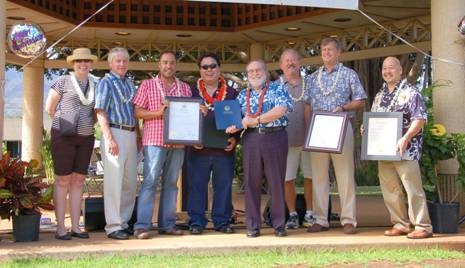 Waialua Public Library (Oahu) celebrated its 85th Anniversary on September 15 at the Waialua Bandstand in the Park, across the street from the Library. Governor Neil Abercrombie, Senator Donovan Dela Cruz and other state and City officials, State Librarian Richard Burns, and more than 400 people attended the free event. Click here to read more. (Photo and text courtesy Hawaii State Public Library System.)
The City and County of Honolulu Commission on Culture and the Arts will select two works of art for the Wahiawa Transit Center and is seeking proposals from artists or artist teams. The budget for each project is $100,000.00. The application deadline is January 11, 2013.
The Wahiawa Transit Center, at 956 California Avenue, is a two-story, 46,000 square foot structure with exterior historic-themed decorative elements. It functions as the main community bus station. The anticipated goal is for artworks that highlight the history and culture of Wahiawa with emphasis on the transportation history of the area.
The artworks are for the interior driveway walls. The West Project location is the west bus driveway and the East Project location is the east bus driveway. The art work may use one or both walls of each driveway for works such as a mural, frieze, fresco, sculpture, or other wall-mounted works of art that are permanently installed. The work of art may be installed on a substrate to be attached to the existing wall.
The selected artist or artist team must comply with Federal Transit Administration contractor requirements due to U.S. Department of Transportation Federal Transit Administration funding of the commission.
Applications must be received by 4 p.m. on January 11, 2013 at:
Mayor's Office of Culture and the ArtsFor application requirements, project details, and other information please visit www1.honolulu.gov/moca/news.htm or contact Registrar E. Tory Laitila at (808)768-4105, or email him at tlaitila@honolulu.gov.
Attention: Art for Wahiawa Transit Center
550 South King Street, Room 203
Honolulu, Hawaii 96813.
Since the closure of Karsten Thot Bridge on Sept. 17 for emergency repairs, the state Dept. of Transportation (DOT) continues to work with the Honolulu Police Dept. (HPD), US Army Garrison Hawaii and the 25th Infantry Division to make traffic pattern and scheduling adjustments to minimize traffic congestion. Below is an update on traffic measures currently in effect. DOT thanks motorists for their continued patience during this necessary bridge repair work.
• The Karsten Thot Bridge southbound lane is open from 5 - 9 a.m. on weekdays, excluding holidays. Pedestrian traffic is allowed over the bridge at all hours using the designated walkway.Information is subject to change and adjustments are continually being made to improve traffic flow. Motorists are advised anticipate delays and allow for extra travel time.
• HPD special and regular duty officers are providing rush-hour traffic control through major intersections in the mornings and afternoons on weekdays, excluding holidays.
• Schofield traffic exiting McNair Gate is limited to right turns only, turning south onto Wilikina Dr., from 5 - 7:30 a.m. and 4 - 6:30 p.m. Left turns into McNair Gate from Wilikina Dr. will not be allowed during these hours.
• Schofield traffic exiting Macomb Gate is limited to left turns only, turning north onto Wilikina Dr., from 4 - 6:30 p.m. Left turns into Macomb Gate from Wilikina Dr. are allowed during these hours.
• Modified traffic patterns at Schofield Barracks' Lyman Gate and Wheeler Army Airfields Kawamura Gate will continue, accommodating a higher volume of traffic during peak hours.
(Honolulu Civil Beat) - Earlier this year, Hawaii gained the dubious distinction of having the worst traffic in the nation and some of the worst roads.
Now, the state can add another poor rating to the mix: a CNBC special report named Hawaii the second-to-worst state in the nation for business in 2012.
State officials weren't surprised by the news.
"We always rank at the bottom. It's not something new," said Eugene Tian, the economic research administrator at the Hawaii Department of Business, Economic Development & Tourism. Last year, Hawaii only did marginally better in the rankings - 48 out of 50.
Sen. Donovan Dela Cruz said that despite its predictability, the low score should still be cause for concern.
"It's not enough just to agree we're anti-business," he said. "We have to change it."
Dela Cruz said that because the state ranked at the bottom in almost every category, the study can't be ignored.
"If the rest of the world is looking at the rankings and they're seeing that we're anti-business, how are we going to attract investment?" Dela Cruz said.
Continue reading on Honolulu Civil Beat
(Honolulu Civil Beat) - Editor's Note: This is the second of two columns by Sen. Donovan Dela Cruz discussing why Hawaii is not doing as much as it could to boost the economy and how it can be better.
In 2007, Forbes conducted a study ranking American cities with the best- and worst-paying jobs. Honolulu
received top recognition with above average salaries for busboys, bartenders, and lifeguards. Albeit these are
much needed services, Honolulu needs to push the envelope in reversing the brain drain and keep our local
people here. We need jobs in business, diplomacy, education, technology and science, energy, and film. First
we need to create the environment and the culture to attract investment to achieve synergy and scale to make
those jobs real.
This idea of creating a globally competitive Hawaii also provides possible answers to dealing with budget deficits,
developing public private partnerships and investment opportunities, reversing the brain drain, focusing growth in
the urban core and stopping urban sprawl in its tracks to protect agricultural land. This can only be done by truly
envisioning and achieving regional centers of industry along the rail line:
Technology (Silicon Valley)
Film (Hollywood)
Finance (Wall Street)
Diplomacy (Geneva)
Medicine and health
The possibilities are endless due to location, weather, climate, and culture but leadership, coordination and vision
in government are required.
Continue reading on Honolulu Civil Beat
(Honolulu Civil Beat) - The Whitmore Village Agricultural Development Plan is an effort to help revitalize the economy and agricultural production in Central Oahu, once a region that led the industry with pineapple and other crops. The main objectives are to:
• demonstrate that farming is an attractive profession, agriculture is revenue generating, and a career in agriculture will allow a new generation of farmers the ability to live and work in Hawaii;
• create synergy and scale resulting in reduced costs of farming and ensuring supporting systems and activities become efficient; and
• develop a comprehensive, economically sustainable plan for agriculture that includes farms, packing and processing facilities, distribution systems, infrastructure and water, agri-tourism opportunities, public-private partnerships and long-term investments.
This plan includes the Agribusiness Development Corporation (ADC), Office of Hawaiian Affairs (OHA), private sector partners and small, medium and large local farms.
Continue reading on Honolulu Civil Beat
(Honolulu Civil Beat)
Editor's Note: This is the first of two columns by Sen. Donovan Dela Cruz discussing why Hawaii is not doing as much as it could to boost the economy and how it can be better.
In 1999, the Honolulu Star Bulletin published an article by Lavonne Leong, "Isles Lose Many of the Best and Brightest." When University of Hawaii graduates in finance were asked, "What advice would you offer current and soon-to-be graduating students in your major?" almost twenty-five percent responded, "Move to the mainland."
Let's fast forward to 2012. Is the advice the same?
We have heard the catch phrases of "diversify our economy" and "reverse the brain-drain" time and time again for more than 30 years. We have even heard the terms "gateway" and "where east meets west." And what progress have we made?
The world is rapidly changing and we are discussing the same challenges and reliving the same debates. Same approaches to same problems have given us "what should have been obvious" same results.
Simply put, we must have a common goal to make Hawaii the most globally competitive state and Honolulu the most globally competitive city starting yesterday. We all need to feel the sense of urgency.
Cities encouraging redevelopment and mixed-use are more competitive offering graduates more money, more opportunities and prestige. Simply put, Hawaii is not globally competitive enough to keep students born and raised in Hawaii at home or offer them a lateral profession to draw them back home. Census reports show that in 1997 and 1998, almost 17,000 more people moved from Hawaii to the mainland than vice-versa. Hawaii continues to lose its best and brightest.
This problem stems from a shortage of affordable housing, low-paying salaries, and a lack of opportunities. Yet, in other globally competitive cities high home prices and the high cost of living are offset by higher paying careers.
Continue reading on Honolulu Civil Beat
Over the years we have heard time and again about the diversification of the agricultural industry, food substantiability and security, and the importance of preserving agricultural land.
Unfortunately, a lack of vision, planning, coordination and not making the proper investments have left the industry limping along. We have not restructured government to appropriately respond to the globally competitive situation that places Hawaii farmers at a severe disadvantage. Because of evolving federal regulations and an increasing number of low-priced imports, some local farmers have abandoned their efforts, and younger generations feel the situation is too overwhelming and difficult to pursue.
Now is the time for us to show and execute leadership to create a successful revenue-generating model for agriculture that we can later template all across our state. Continue reading on Midweek.com.
(Hawaii Free Press News Read) - SA: State Sen. Donovan Dela Cruz has asked Oahu Democrats to dismiss a complaint that alleges he violated the party's environmental platform by sponsoring a bill that would have encouraged development around Honolulu rail stations.
The complaint, filed by Lynn Sager, chairwoman of the party's environmental caucus, alleges that the bill was in direct opposition to the party's platform goal of sustaining the environment. Sager and the other activists who signed the complaint want the party to determine whether Dela Cruz should be reprimanded, censured or expelled.
Dela Cruz said his bill was intended to help guide residential, commercial and mixed-use development around Honolulu rail stations and promote transit ridership. The bill died on the last day of the legislative session in May after critics, including many in the environmental community, claimed it could shut the public out of the planning process.
Dela Cruz said the complaint does not reflect "the 'D' that I cherish." Read more on HawaiiFreePress.com.
(Honolulu Star-Advertiser) - State Sen. Donovan Dela Cruz has asked Oahu Democrats to dismiss a complaint that alleges he violated the party's environmental platform by sponsoring a bill that would have encouraged development around Honolulu rail stations.
The complaint, filed by Lynn Sager, chairwoman of the party's environmental caucus, alleges that the bill was in direct opposition to the party's platform goal of sustaining the environment. Sager and the other activists who signed the complaint want the party to determine whether Dela Cruz should be reprimanded, censured or expelled. Read more on StarAdvertiser.com.
(Honolulu Star-Advertiser) - In our nation's quest to form a more perfect union, was there ever thought given to just making people be quiet?
What if the problem we face is not that the issues are too complex, the solutions too costly or the options too limited? Read more on StarAdvertiser.com.
(Honolulu Civil Beat) - This Lanai business is heating up.
Word is that some of Hawaii's state senators don't want the pending sale of the island to go through.
Senate President Shan Tsutsui is said to be sending a letter to Gov. Neil Abercrombie asking him to halt the sale.
They're sick of Lanai being in a constant state of upheaval - and they want to state to condemn the land, or buy it.
"I would hate see Lanai sold and in a constant state of upheaval and transition," said Sen. Donovan Dela Cruz.
Civil Beat reported back in December that Castle & Cooke had put Lanai up for sale. What's new is that Maui's mayor and the governor have been notified that a potential buyer identified. Read more in the Honolulu Civil Beat.
Bill allowing agriculturally based businesses on farmland is signed
(Honolulu Star-Advertiser) - Agriculturally based businesses would be allowed in agriculture districts under a measure signed into law today by Gov. Neil Abercrombie.
Permissible commercial activity includes the preparation and sale of certain food grown by the owner or operator of a retail food establishment and the sale of logo items related to a producer's agricultural operation.
"The ability to be able to take what you grow and turn it into products and to be able to sell it is really what this is all about - to get people used to not just the brand names but the fact that they're able to support agriculture as a result," Abercrombie said. Read more on StarAdvertiser.com.
(Honolulu Star-Advertiser) - Agriculturally related businesses would be allowed on farm land under a measure signed into law Friday by Gov. Neil Abercrombie.
Permissible commercial activity includes the preparation and sale of certain food grown by the owner or operator of a retail food establishment and the sale of logo items related to a producer's agricultural operation.
"The ability to be able to take what you grow and turn it into products and to be able to sell it is really what this is all about - to get people used to not just the brand names but the fact that they're able to support agriculture as a result," Abercrombie said.
The proposal, Senate Bill 2375, was introduced by Sen. Donovan Dela Cruz (D, Kaena-Wahiawa-Pupukea).
"Farmers are being forced to diversify their products in order to make ends meet while continuing to provide local food for the community," he said. "This bill allows for additional opportunities for them to create revenue." Read more on StarAdvertiser.com.
(Hawaii 24/7) - Gov. Neil Abercrombie has signed a number of measures into law including two bills that are aimed to benefit local farmers who want to sell their products and/or establish agricultural-based commercial operations.
Senate Bill 2375 authorizes agricultural-based commercial operations in agricultural districts that will increase farmers' ability to sell their products and promote food sustainability for the islands.
Senate Bill 2646 is intended to promote and support diversified agriculture by exempting certain nonresidential agricultural buildings that are on commercial farms from county building permit requirements.
"To truly support our local farmers we must empower them," Abercrombie said. "These measures not only provide for that to take place but it also promotes diversified agriculture. I want to thank the Legislature for recognizing the importance of helping our farmers."
Sen. Donovan Dela Cruz, who introduced SB 2375 stated, "Farmers are being forced to diversify their products in order to make ends meet while continuing to provide local food for the community. This bill allows for additional opportunities for them to create revenue."
SB 2375 immediately goes into effect; SB 2646 is effective July 1, 2012. Read more on Hawaii247.com.
My long-term goal is to transform the area into a modern agriculture processing and distribution hub to reduce the dependence on imported produce.
Farmers are forced to make a substantial investment to meet food safety standards, thus escalating the cost for Hawaii's local producers. Those who eventually will farm on the Galbraith lands must invest in constructing food safety-certified facilities and/or transport their produce elsewhere, which would add to their overhead costs.
The state made a solid commitment to secure portions of Galbraith Estate to promote farm ownership and diversified agriculture. I believe that the acquisition of this land with the facilities in Whitmore will provide opportunities for farming and related agricultural industries. Read more on Midweek.com.
(Pacific Business News) - The state Legislature's failure to pass laws designed to spur transit-oriented development along the 20-mile rail-transit line being built between Kapolei and Ala Moana Center could derail such projects before they even get started, developers said.
Senate Bill 2927, which was introduced by Sen. Donovan Dela Cruz, D-Kunia Village-Mililani Mauka-Wahiawa, would have waived development fees and eased some requirements for transit oriented development, or TOD, near the rail's 21 stations.
"What transit serves as is not only as a way to move passengers, it is also an economic engine," said Michael Dieden, president of Los Angeles-based Creative Housing Associates.
"It's definitely a short-sighted economic blow to the Honolulu economy," he said about S.B. 2927's failure.
Private-public partnerships for TOD that have incentives from the government are essential for encouraging development around transit, and it's done all over the world, he added. Dieden's company has done work extensively in Southern California and in the Bay Area. Read more in Pacific Business News.
(HawaiiNewsNow) - Queen Liliuokalani School in Kaimuki ceased to be a school this past year, when the Board of Education decided to close it. Education officials said the campus and its buildings would be used for a teacher resource center and storage. But it's not generating any revenue for the state. A measure in the legislature would allow that to happen through public-private partnerships.
Under the bill, the state could identify what lawmakers call "underutilized assets. The former Liliuokalani School campus would be one example. Read more on HawaiiNewsNow.com
(Honolulu Star-Advertiser) For almost a decade, a push to draw more Korean visitors to Hawaii has spurred the growth of the Korean business district in urban Honolulu.
A Korean "superblock," anchored by Palama Super Market, sits at the corner of Kalakaua Avenue and Makaloa Street. It's one of several strip malls that cater to Korean customers.
Read more on StarAdvertiser.com
(Pacific Business News) Rarely do developers in Hawaii get any kind of break when it comes to fees and other requirements. And, while we often wish that local and state governments were easier to do business with, we do not have problems with reasonable laws designed to ensure the thoughtful use of our natural resources.
At the same time, we think the state would not be violating this approach even if it were, on occasion, to give developers some motivation for growth that helps achieve a well-planned and highly desired outcome.
That is why - despite our objections to the elevated-rail transit system ...
Read more in Pacific Business News
(Pacific Business News) The state is trying to entice potential transit-oriented developers to build along the planned 20-mile route of Honolulu's elevated rail-transit system by passing a law that would waive development fees and ease some other requirements. The legislation also would help fast-track the development process near the rail stations.
Senate Bill 2927, introduced by Sen. Donovan Dela Cruz, D-Kunia Village, Mililani Mauka and Wahiawa, has passed the Senate and is currently in the state House.
State and City and County of Honolulu officials said they are hopeful the bill will help encourage development along the rail line from Kapolei to Ala Moana...Read more in Pacific Business News
Senator Donovan M. Dela Cruz has introduced Senate Bill 2274, a measure that would require county animal control officers to establish a process for permitting and inspecting the premises of dog breeders. In February 2011, the Hawaiian Humane Society rescued 153 dogs from Bradley International, a commercial breeding operation in Waimanalo. The Waimanalo business has brought media attention and discussion about the industry.
Moved by the news of the animal rescue, Senator Dela Cruz agreed to be a foster parent to two French bulldogs, that he named Ola and Liko, that were part of the group animals forfeited by the owner of Bradley International. He has since been able to adopt the two dogs. Touched by the ordeal his pets went through, Senator Dela Cruz said, "It is incredible to observe how providing nurture and love to dogs can foster changes in their personality, from dogs that were once fearful to dogs that are now happy and fun loving."
Read more on HawaiiSenateMajority.com
(KHON2)"It's disturbing to see the animals used in that fashion." said Dela Cruz.
That's why he introduced Senate Bill 2274.
"It will establish and identify animal control officers in each county and they would develop a process for permitting. That way dog breeders or anyone associated with dog breeding will have to follow that process," said Dela Cruz.
It would also establish a process for inspecting the dog breeding facilities.
Read more on KHON2.com
(Associated Press) Parents and guardians who fail to report missing children could face felony charges under a bill before the Hawaii Senate.
Sen. Donovan Dela Cruz introduced a bill he called "Caylee's Law," which refers to a widely-publicized missing child case in Florida.
The bill is named for Caylee Anthony, whose mother Casey Anthony didn't report Caylee's disappearance for about a month.
Dela Cruz said his bill places greater responsibility on parents and guardians by holding them accountable for reporting missing children in a timely manner. The bill would make it a felony if a parent or guardian fails to report the disappearance of a child under 12 within 48 hours.
Also posted on KITV.com, the Honolulu Star-Advertiser, and The Republic.
In reaction to the death of 2-year-old Caylee Anthony, Senator Donovan M. Dela Cruz has introduced a measure that would make it a felony for a parent or guardian who fails to report a missing child 12 years old or younger within 48 hours to a law enforcement agency. The bill, Senate Bill 2275, is being referred to as "Caylee's Law."
The disappearance of Florida girl Caylee Anthony sparked public debate and outrage across the country. Casey Anthony, the mother of Caylee, did not report the child's disappearance for about a month after her disappearance.
"This bill focuses on protecting Hawaii's keiki by ensuring that greater accountability and responsibility be placed on parents and guardians to report a missing child in a timely manner," said Senator Donovan M. Dela Cruz, who represents District 22, which encompasses the areas of Mililani Mauka, Wahiawa, Whitmore, Hale‘iwa, Mokule‘ia, Waialua, Sunset Beach, Pupukea. "My office received a large of number emails requesting that something be done to prevent such future instances."
The bill would also impose a duty on parents and guardians to report the death of a child or the location of a child's corpse to law enforcement agency within 2 hours of discovery. Failure to do so would result in a felony. View the media release
(from KITV.com) Sen. Donovan Dela Cruz is introducing a measure that would require a driver to take certain safety precautions when approaching an emergency vehicle that is stopped ahead of a driver while performing official duties.
Senate Bill 2663 requires approaching drivers to slow down and make a lane change to an adjacent lane away from the stopped emergency vehicle.
If the bill becomes law, a driver would face a misdemeanor if convicted. If the violation results in fatality, the driver could face up to a charge of negligent homicide in the first degree.
"We have lost two Honolulu Police officers while in the line of duty over the past four months. We must enact laws that further protects and ensures the safety of our emergency responders," said Sen. Donovan M. Dela Cruz, who represents District 22, which encompasses the areas of Mililani Mauka, Wahiawa, Whitmore, Hale‘iwa, Mokule‘ia, Waialua, Sunset Beach, Pupukea. "Our community mourns the loss of the Honolulu Police officer who was stationed in Wahiawa." Read more at KITV.com
In the wake of a recent tragic traffic fatality involving a Honolulu Police officer, Sen. Donovan M. Dela Cruz is introducing a measure that would require a driver to take certain safety precautions when approaching an emergency vehicle that is stopped ahead of a driver while performing official duties.
Senate Bill 2663 requires approaching drivers to slow down and make a lane change to an adjacent lane away from the stopped emergency vehicle. If the bill becomes law, a driver would face a misdemeanor if convicted. If the violation results in fatality, the driver could face up to a charge of negligent homicide in the first degree.
"We have lost two Honolulu Police officers while in the line of duty over the past four months. We must enact laws that further protects and ensures the safety of our emergency responders," said Sen. Donovan M. Dela Cruz, who represents District 22, which encompasses the areas of Mililani Mauka, Wahiawa, Whitmore, Hale'iwa, Mokule'ia, Waialua, Sunset Beach, Pupukea. "Our community mourns the loss of the Honolulu Police officer who was stationed in Wahiawa." View the media release
(from the Honolulu Star-Advertiser) "We need to hear a strategy on how we're going to move the economy forward," said state Sen. Donovan Dela Cruz (D,Kaena- Wahiawa-Pupukea). "The governor has talked about quick fixes in regards to CIP (capital improvement projects) and construction, so we need to make sure that there is a process to achieve that. And I think the Senate has already put forward a position that we're going to support a lot of money and projects. There is already a number of Senate vehicles looking at how we can expedite streamlining so we can get those projects on line."
Dela Cruz said Hawaii has to position itself to become more economically competitive in the Pacific and more globally relevant so the state is not as vulnerable to short-term swings in the economy. "We really need to be at the point where we're not reacting to things," he said, "that we're going to be positioning the state for the future." Read more in the Honolulu Star-Advertiser
HONOLULU -- Senator Donovan M. Dela Cruz, chair of the Senate Committee on Water, Land and Housing (WLH), is hosting the Department of Land and Natural Resources' (DLNR) North Shore Listening Session on Tuesday, January 31. The DLNR Administration team, including Chairperson William J. Aila, Jr., First Deputy Guy H. Kaulukukui, and Water Deputy Bill M. Tam, will attend to hear community comments, questions, and concerns regarding topics under the Department's jurisdiction. This final meeting on O'ahu concludes a series of listening sessions being held statewide over the past several months.
Senator Donovan M. Dela Cruz (D22-Mililani Mauka, Wahiawa, Whitmore, Hale'iwa, Mokule'ia, Waialua, Sunset Beach, Pupukea), has been coordinating and attending these talk story sessions. "The meetings and site visits DLNR has been conducting is unprecedented and have been very successful. I applaud Director Aila and Deputy Kaulukukui for attending these sessions to help Senators address community concerns and needs," he said.
"I encourage everyone to attend the listening session, especially if they have any concerns or comments on any function, activity or project under DLNR's jurisdiction," Senator Dela Cruz added.
"These listening sessions are purely for the Department to visit with communities and receive feedback on the communities' ideas and concerns relating to Department responsibilities," said William J. Aila, Jr., Chairperson of DLNR. "Community participation is essential to caring for our land and natural resources in Hawaiʻi."
The DLNR is responsible for managing 1.3 million acres of state land, 3 million acres of state ocean waters, 2 million acres of conservation district lands, our drinking water supply, our fisheries, coral reefs, indigenous and endangered flora and fauna, and all of Hawaiʻi’s historic and cultural sites. DLNR's management responsibilities are vast and complex, from the mountaintops to three miles seaward of our beautiful coasts. The health of Hawaiʻi's environment is integral and directly related to its economy and quality of life.
For more on DLNR and its divisions visit www.hawaii.gov/dlnr.
If you are unable to attend but would like to send your comments, questions, and concerns to the DLNR please e-mail: DLNR2011ListeningSessions@hawaii.gov .
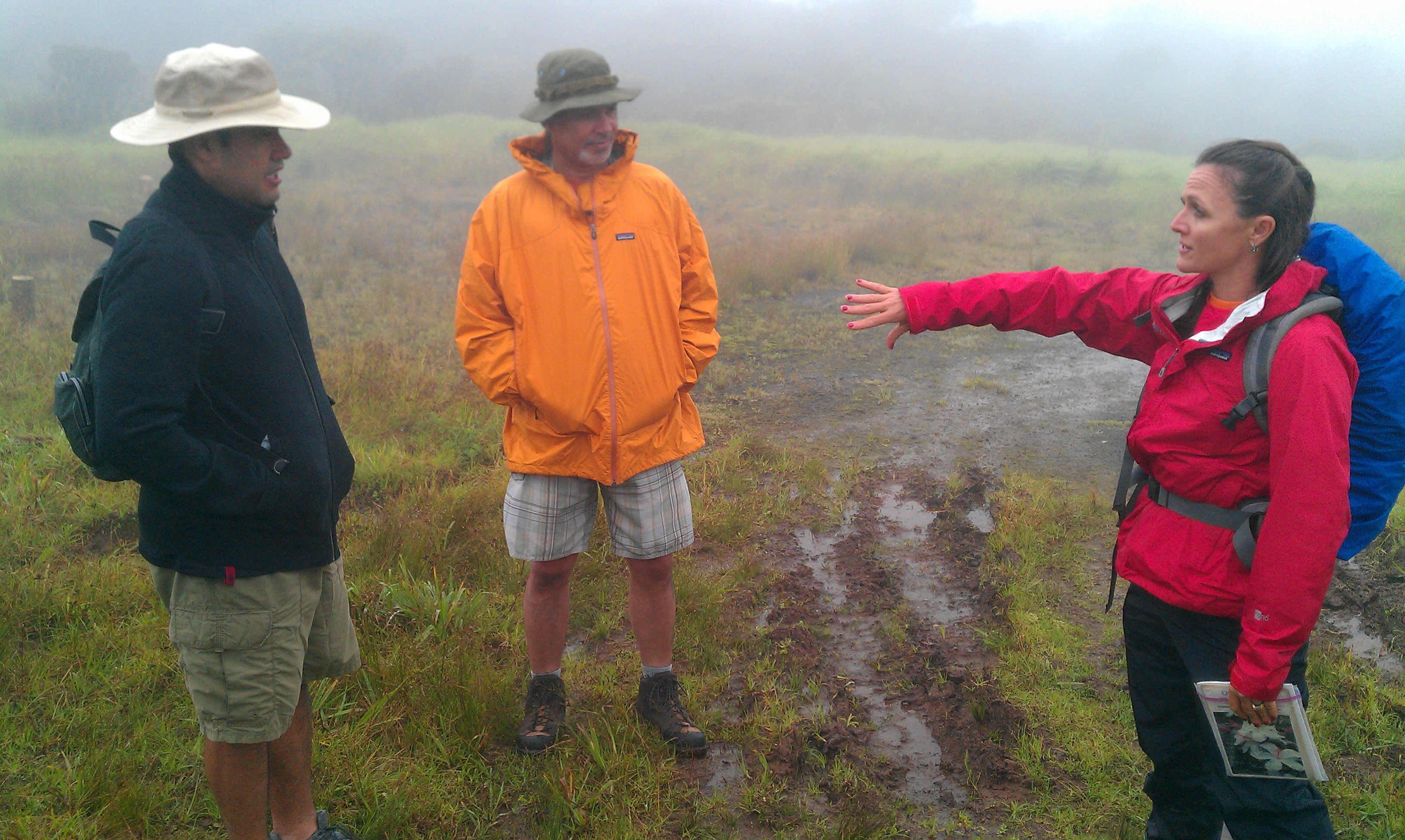 (From L to R: Senator Donovan Dela Cruz; First Deputy Guy Kaulukukui, Dept. of Land & Natural Resources; and Marigold Zoll, Division of Forestry & Wildlife, at the summit of Mt. Kaala discussing watershed protection.)
The Natural Area Reserves System (NARS) was established to preserve and manage Hawaii's natural resources. The system presently consists of 20 reserves on five islands, encompassing 123,431 acres of the State's most unique ecosystems, many of which occur nowhere else in the world. On Oahu's Mt. Kaala, rare native plants and animals, like the critically endangered Oahu Tree Snail, or kahuli, cling to existence in an ancient Hawaiian forest near the misty summit.
Currently, these fragile ecosystems are under attack. Invasive pests wreak havoc on our native forest which has dire consequences if left unchecked. Due to extensive budget cuts to the Department of Land and Natural Resources (DLNR), NARS must rely on the Federal government and an extensive volunteer group to assist in management projects that include the removal of feral ungulates and non-native weeds.
Senator Dela Cruz believes that the State must make a solid commitment to ensure that our native forests will be around for now and in the future. Understanding the important role that native forests play in our State's water resources and economy, Senator Dela Cruz has dedicated his efforts to seek stable funding for the preservation of special places like Mt. Kaala for future generations.
HONOLULU -- The Senate Committee on Water, Land and Housing (WLH) Chair Senator Donovan M. Dela Cruz is hosting the Department of Land and Natural Resources' (DLNR) O‘ahu Listening Session on Monday, January 9. The DLNR Administration team, including Chairperson William J. Aila, Jr., First Deputy Guy H. Kaulukukui, and Water Deputy Bill M. Tam, will attend to hear community comments, questions, and concerns regarding topics under the Department's jurisdiction. DLNR has been attending listening sessions statewide over the past several months.
Senator Donovan M. Dela Cruz (D-Mililani Mauka, Wahiawa, Whitmore, Hale‘iwa, Mokule‘ia, Waialua, Sunset Beach, Pupukea), has been coordinating and attending these talk story sessions. "The meetings and site visits DLNR is conducting are very successful and have never been done before. Director Aila and Deputy Kaulukukui are being proactive in conducting these sessions to help Senators address community concerns and needs," he said.
"These listening sessions are purely for the Department to visit with communities and receive feedback on the communities' ideas and concerns relating to Department responsibilities," said William J. Aila, Jr., Chairperson of DLNR, "community participation is essential to caring for our land and natural resources in Hawai‘i."
The DLNR is responsible for managing 1.3 million acres of state land, 3 million acres of state ocean waters, 2 million acres of conservation district lands, our drinking water supply, our fisheries, coral reefs, indigenous and endangered flora and fauna, and all of Hawai‘i's historic and cultural sites. DLNR's management responsibilities are vast and complex, from the mountaintops to three miles seaward of our beautiful coasts. The health of Hawai‘i's environment is integral and directly related to its economy and quality of life.
For more on DLNR and its divisions visit www.hawaii.gov/dlnr.
If you are unable to attend but would like to send your comments, questions, and concerns to the DLNR please e-mail: DLNR2011ListeningSessions@hawaii.gov.
"This is the chance for Honolulu to position itself as globally competitive. This is a rare opportunity. We need to showcase ourselves as world leaders in cultural relations, environmental management, education, technology, agriculture, tourism, and economic development"
Read more on HawaiiBusinessOnline.com.
Today, many farmers are struggling to make ends meet. While meeting and speaking with them, we begin to notice a trend with concerns in areas such as food safety, agriculture theft and vandalism, rising land cost, and the availability of financing. Our plan is to introduce a legislative package in the upcoming session that will assist local farmers to overcome some of these challenges.
Across the State farmers are constantly falling victim to ag theft and vandalism whether it is bananas being stolen from a farm in Windward Oahu or the butchering of papaya trees on Hawaii Island. These types of crimes and senseless acts drastically affect a farmer's livelihood. We plan to create tougher penalties against agriculture crimes. The legislation that we are proposing would increase the penalty from a citation to a criminal offense. The intent is to impose harsher penalties to prevent such crimes from occurring. Further, we are proposing to appropriate funds to the Department of Agriculture for stricter enforcement to curb agriculture related crimes.
The biggest challenge, which many farmers can attest to is financing. In order to build a food safety certified facility or install security cameras on a property, farmers would need a large amount of working capital. While various grants and loans are available for farmers to obtain such capital, we are proposing to amend the law to increase the eligibility and permitted use for our State's loan guarantee. The current loan program requires a project to be located on important agricultural lands (IAL). Under our proposal, we would like to include, but not be limited to, all agricultural lands. By doing so, we can encourage more farmers to make critical improvements at a reasonable cost. In addition to the amendment, the creation of a business plan program facilitated by a non-profit will be included to provide the technical assistance for farmers to draft a sound business proposal.
Food safety issue continues to be a challenge for local farmers because of evolving multiple standards imposed on them by private companies with which they do business. Some of these standards were designed for large corporate farms while the vast majority of farms in Hawaii are much smaller in scale and family owned. Rather than waiting for the Federal Government to develop standards that will apply to all farmers, we are introducing legislation to allow the Department of Agriculture to develop a State uniform food safety standard that supersedes all others. It is practical and reasonable to have one set of standards to which everyone adheres. It would eliminate confusion as to which or whose set of standards take precedent. The State can then also assist those farmers who need help meeting food safety requirements.
Our goal is to achieve sustainability but without help, our agriculture industry cannot survive.

Pictured (L-R) Dr. Stuart Nakamoto, Sen. Dela Cruz, Dr. Jari Sagano
"Several mariners are seeking help to address issues with the depth of the channel at Lahaina Harbor, attributing the problem of sand deposits to the surge from the March 11, 2011 tsunami and subsequent swells."
Please visit Maui Now for article and video.
DC808 caught up with state Sen. Donovan Dela Cruz in downtown Washington on Friday.
Dela Cruz participated in the Leadership for Healthy Communities summit on obesity prevention.
For more information please visit Civil Beat for an article and video.
The Caylee Anthony case has attracted widespread attention worldwide. With the acquittal of Casey Anthony of her daughter, Caylee's, disappearance and subsequent death, there has been much anger with thousands of Facebook postings and a "I Hate Casey Anthony" Facebook page, resulting in death threats as reported by CNN. Many people feel the justice was not served.
In the days following the verdict, I received many emails from all over the island proposing that we need laws to make it a felony if parents, guardians, and caretakers do not report the disappearance of a child in a timely matter.
I do agree that unless there is timely reporting of a child's disappearance, it becomes much more difficult for authorities to find the child and find the child safe before a tragic occurrence happens.
Therefore, my office is working on drafting pertinent legislation to address this kind of situation if no such law exists. I am proposing that the disappearance of a child needs to be reported within 24 hours and failure to do so, will be a felony. We need to protect our innocent children and prevent a similar situation from ever happening again. I plan to introduce the bill at the next legislative session in January.
On March 24, the Senate Committees on Water, Land, and Housing, and Hawaiian Affairs met with representatives from the Office of Mauna Kea Management, the University of Hawai‘i, and concerned agencies and community members to discuss the plan to integrate the Hawaiian culture into the management and operations of Big Island's Mauna Kea Lands. They explored possible solutions to sustain the ecological, cultural, and financial viability of Mauna Kea.
View the video on ‘Olelo or scroll down to the Videos section.
 State legislators took a tour of the Big Island to inspire out-of-the-box-thinking to address important issues such as green job creation, food and energy self sufficiency, agricultural diversity, and the challenges faced by agricultural businesses. They visited a number of sites such as Green Point Nursery, Pacific Basin Agricultural Research Center, Puna Geothermal Venture's power plant, the proposed 30-meter telescope on the summit of Mauna Kea, Kamuela Vacuum Cooling Plant, and Hamakua Springs Country Farm.
Participating legislators included members from Senate Committees on Water, Land, and Housing, and Agriculture; and the House Committees on Water and Land, and Agriculture; and Cabinet members from the Departments of Agriculture and Land and Natural Resources.
Please click here for a video of the tour.
Click here to watch the video on blip.tv.
The Kaua‘i County Farm Bureau put together last fall a Commodity Committee, which prepared a list of issues to present the senators.
Wayne Katayama, from Kaua‘i Coffee and the Hawai‘i Coffee Growers Association, said ever since the Kaloko Dam broke in March 2006 there has been a large focus on administrative and safety standards for all reservoirs in the state.
The state Department of Land and Natural Resources on Nov. 22 approved a new set of administrative rules for inspection and maintenance of dams and reservoirs, Katayama said. With those rules, the DLNR also set a schedule for the impoundment of water and implementation of construction and improvement fees.
Click here to read the article on TheGardenIsland.com.
State Senators get acquainted with Hanapepe salt pan salt presented to them by Ku‘ulei Santos during a visit to the salt pans. One of the concerns Santos expressed was the closure of half of the Burns Field (Port Allen Airport) air strip in the background to create parking for parking for visitors to the area. Ku‘ulei Santos talked about issues impacting the operation there, and how the traditional, 2,000-year-old history of salt-making in that area is among other things the only place in the world salt is made via an evaporation technique this close to the ocean. "We are meeting with leaders in the farming community to discuss their direct concerns and also to take a firsthand look to better understand their needs," said Dela Cruz.
Click here to read the article on TheGardenIsland.com.